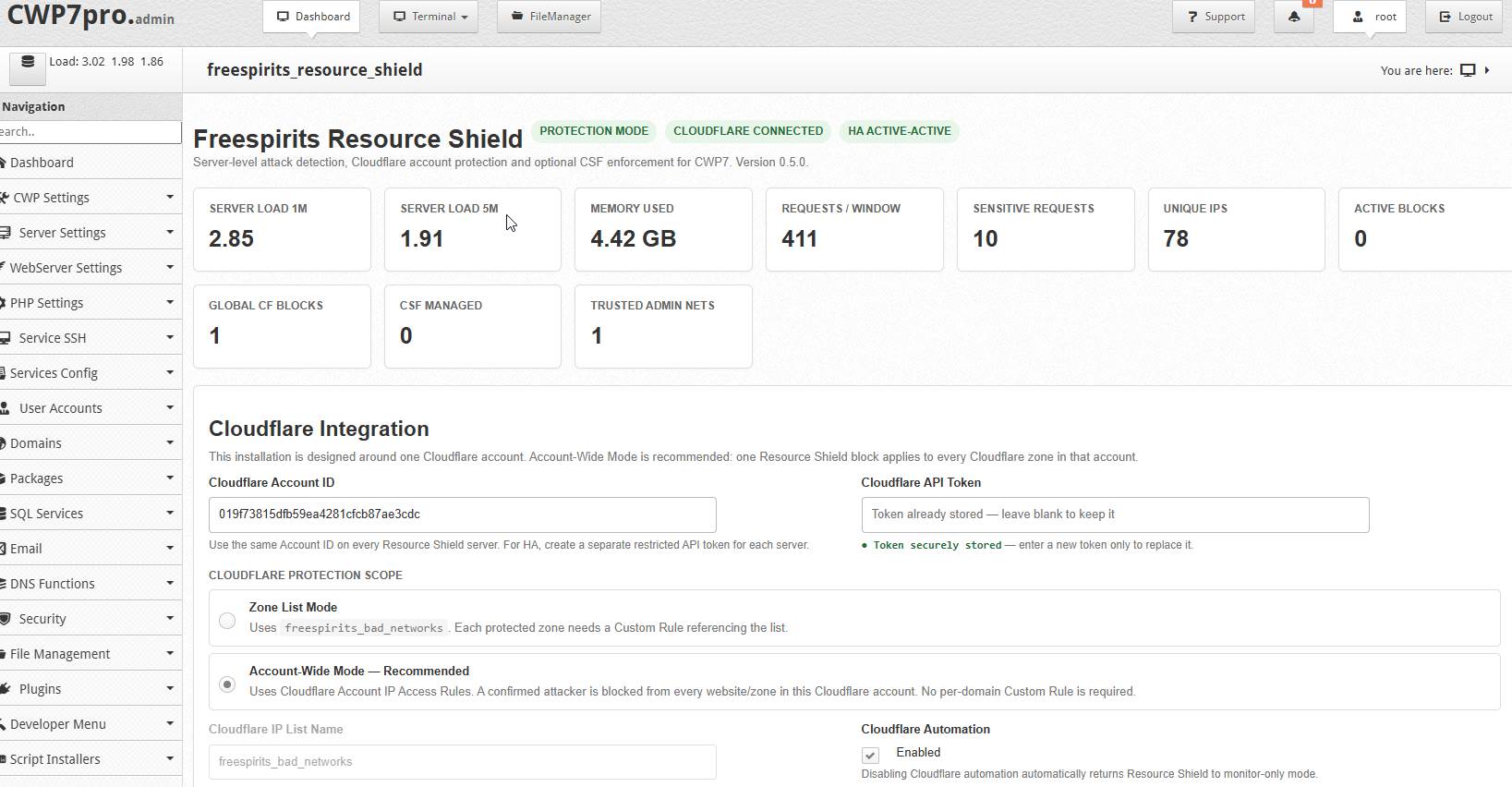
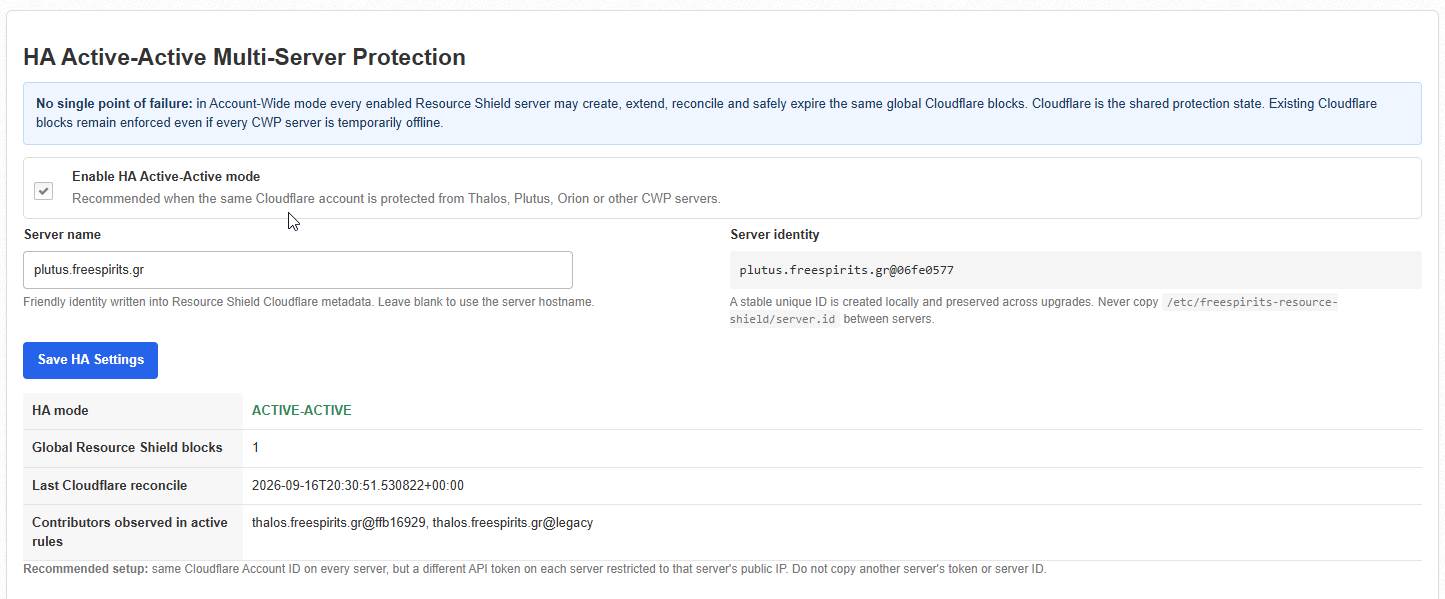
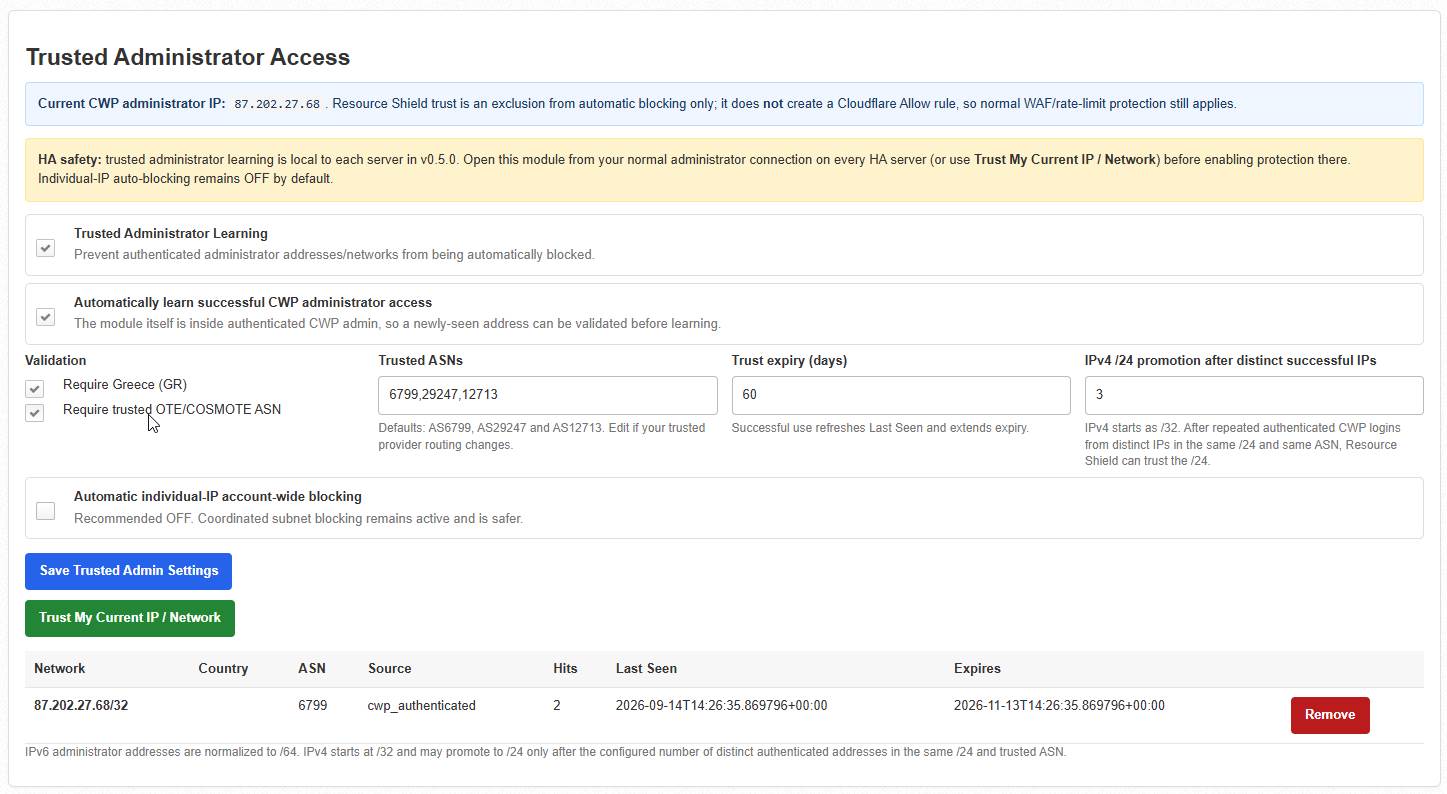
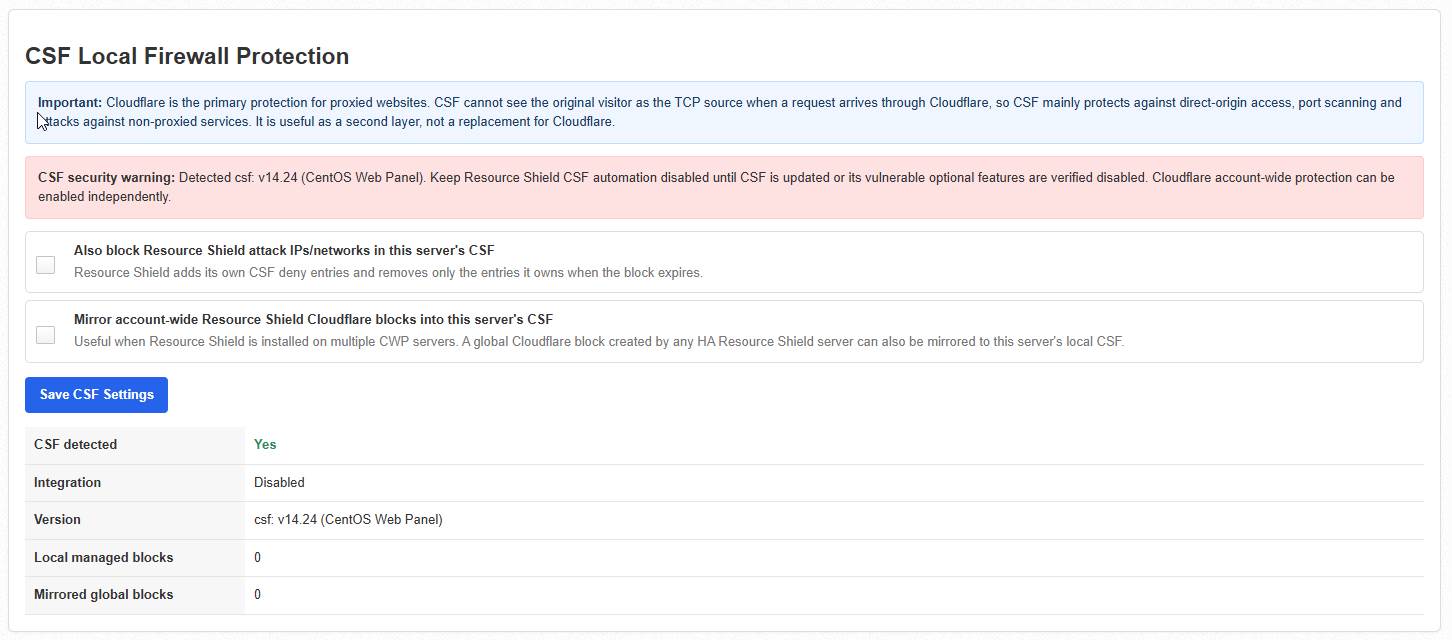
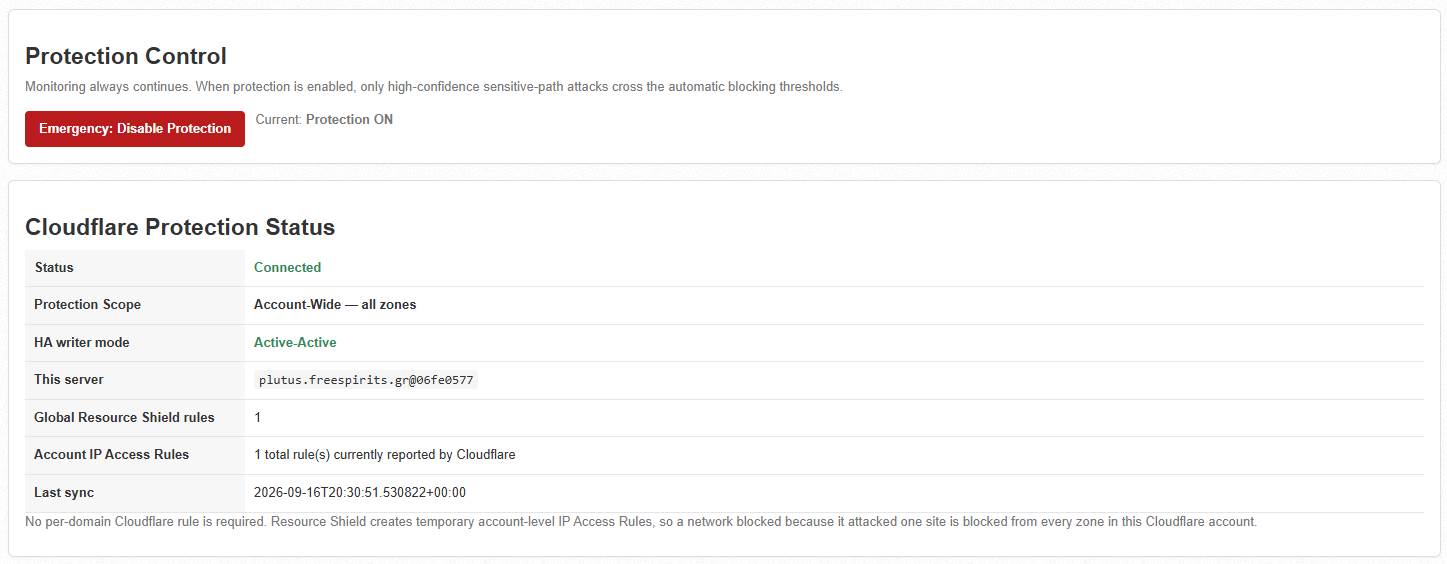
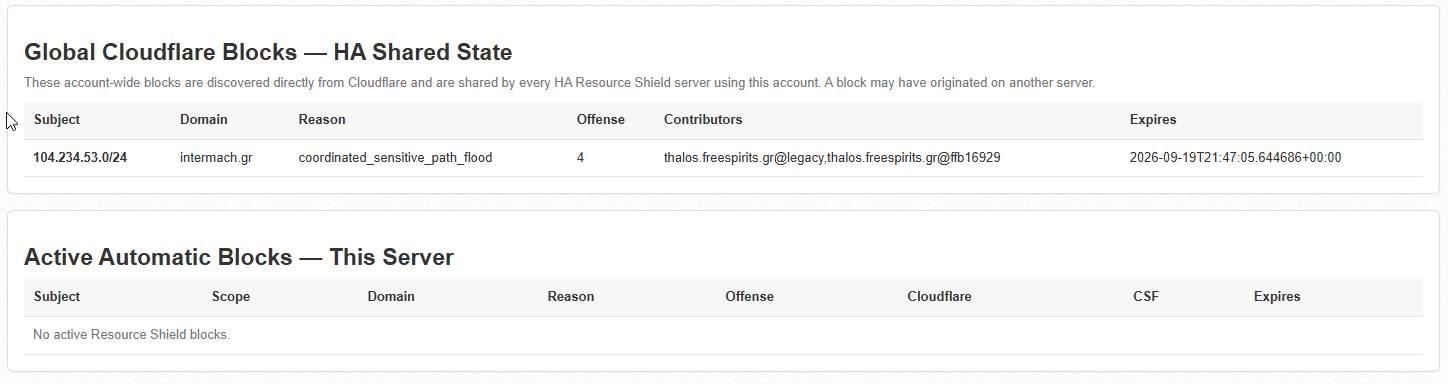
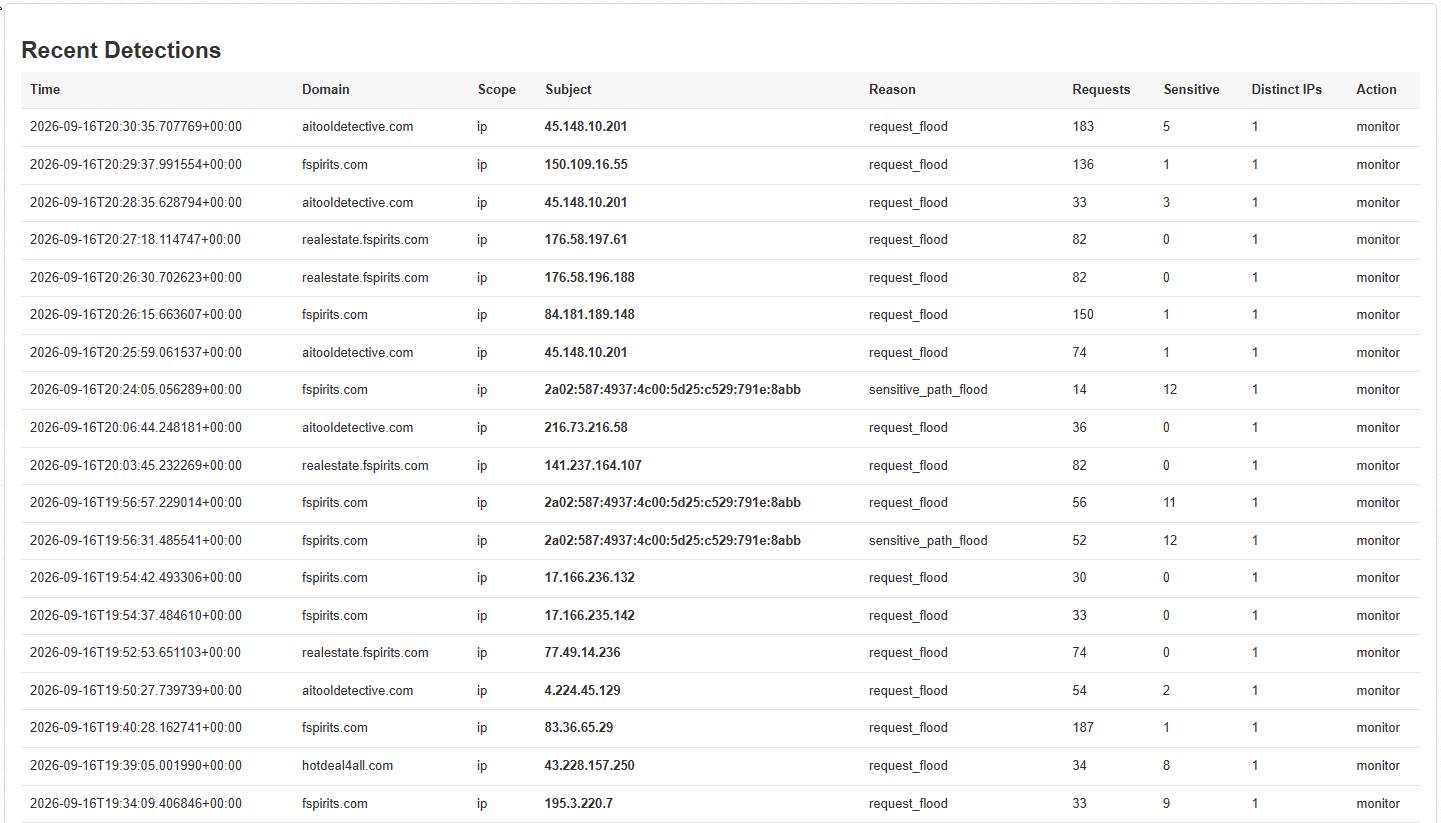
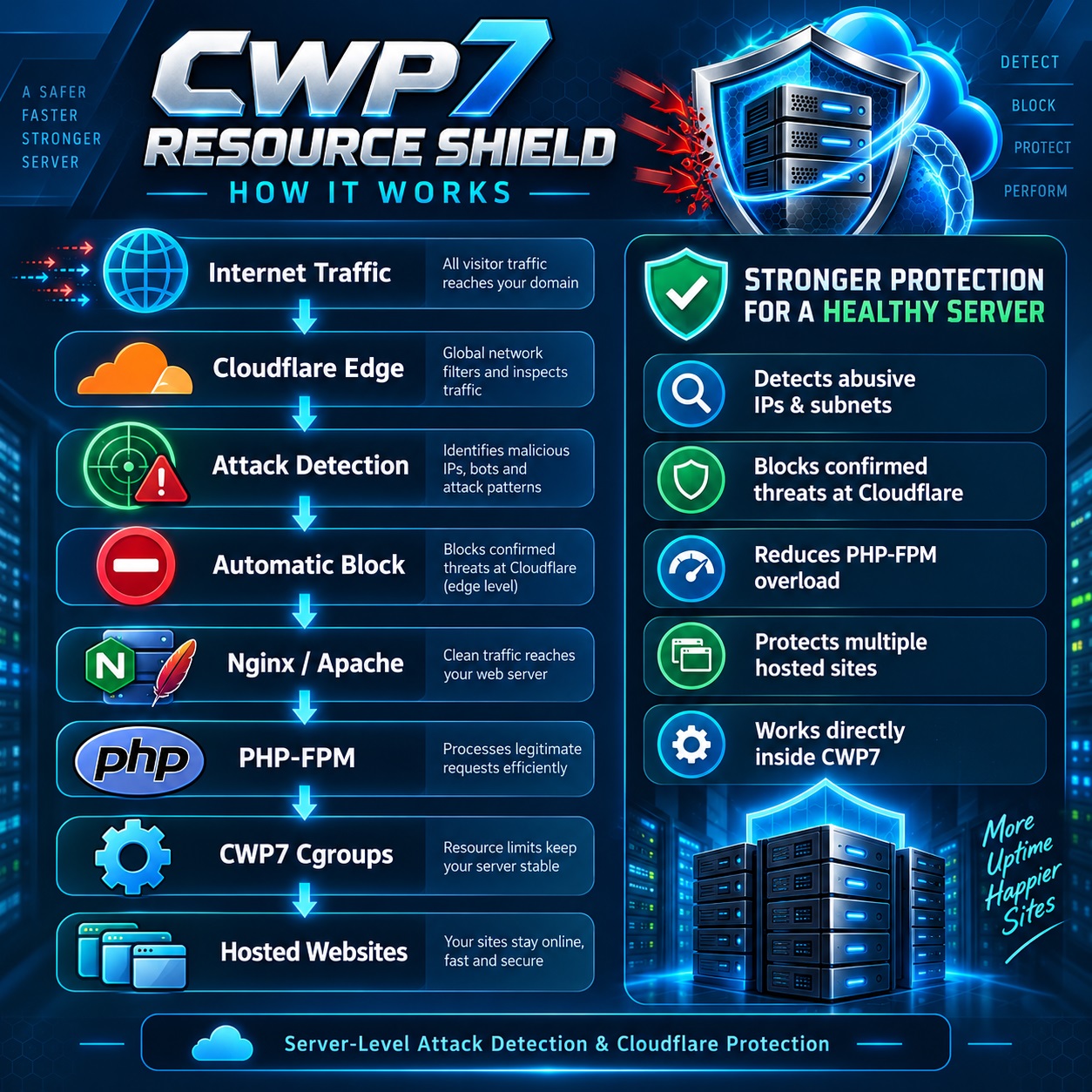
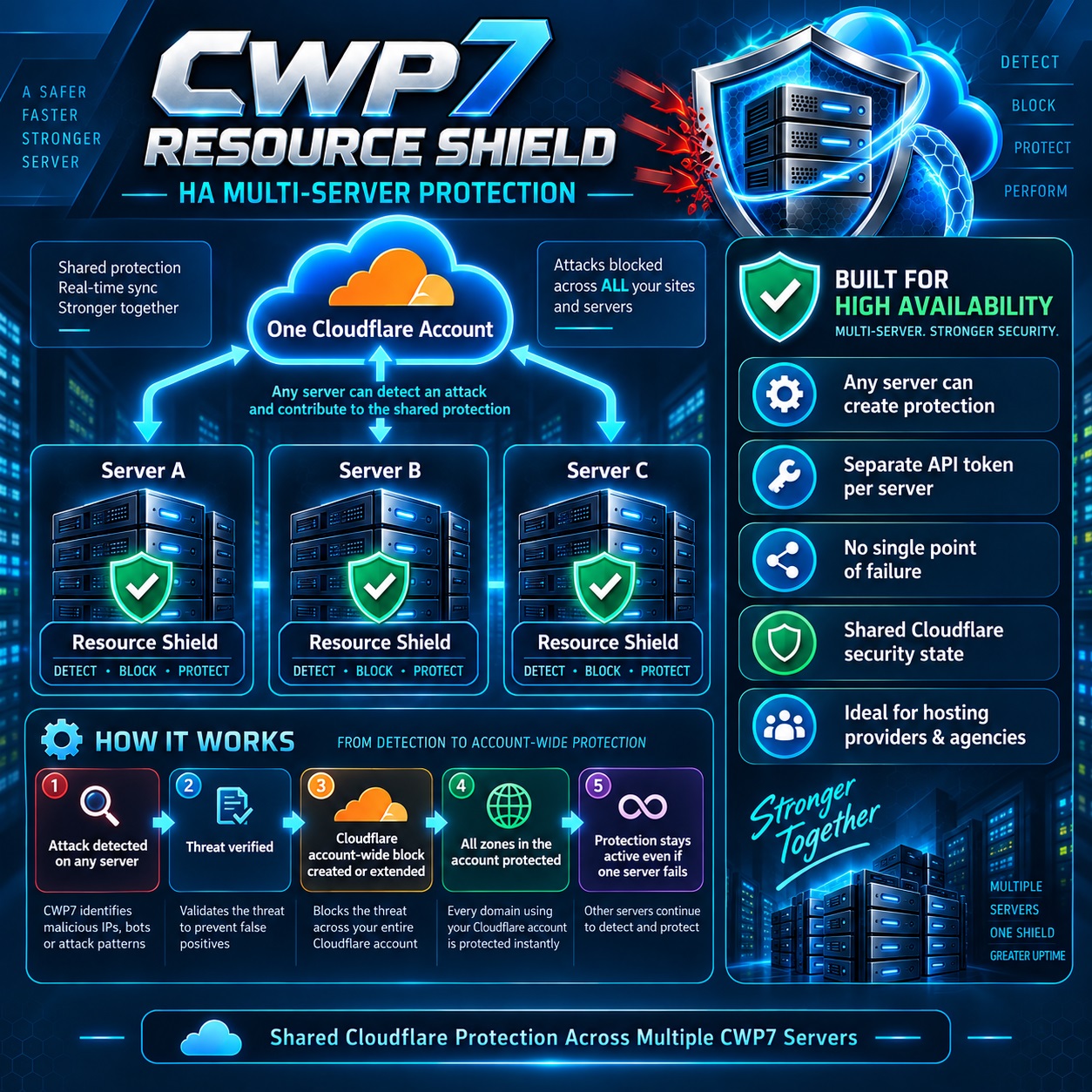
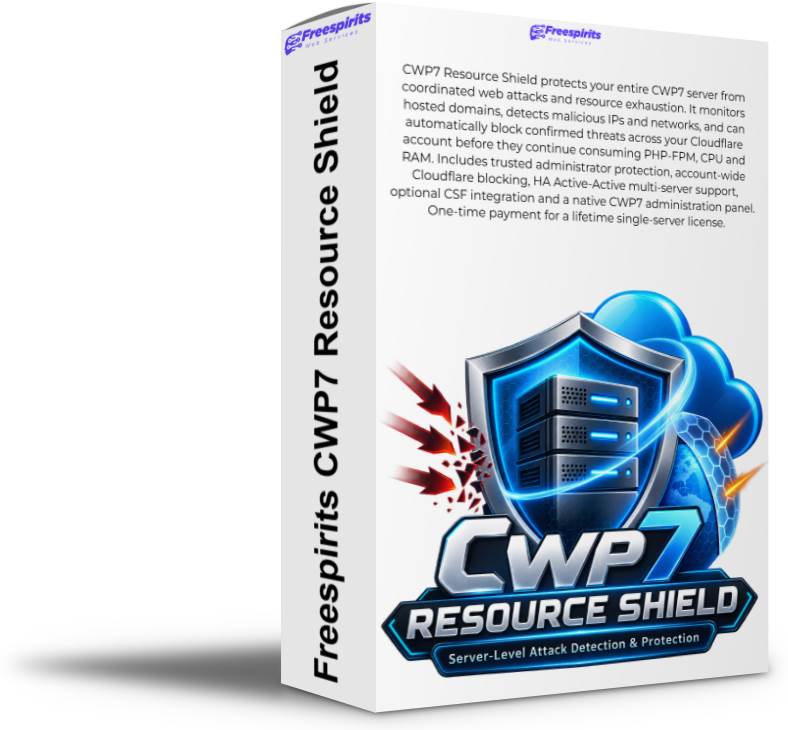
CWP7 Resource Shield protects your entire CWP7 server from coordinated web attacks, abusive traffic and resource exhaustion. It monitors hosted domains, identifies malicious IP addresses and networks, and can automatically block confirmed threats through Cloudflare before they continue consuming valuable PHP-FPM, CPU, RAM and database resources. Includes Cloudflare account-wide protection, trusted administrator access, intelligent network detection, HA Active-Active multi-server support, optional CSF integration, Monitor and Protection modes, and a native CWP7 administration panel. Ideal for hosting providers, server administrators, agencies and developers who want to protect the server itself — not just individual websites.
Smarter traffic containment. More room for real visitors.
A serveur-level protection module for Control Web Panel that combines request intelligence, optional Cloudflare and CSF enforcement, per-account Nginx admission controls and PHP-FPM visibility. Designed to help l'hébergement administrators contain abusive traffic while keeping legitimate visitor journeys in focus.
Protect serveur capacity without disrupting normal visitors
On a shared l'hébergementserveur, one busy application can affect others. Repeated catalogue searches, expensive dynamic pages, login probes and automated requests may occupy PHP-FPM workers, trigger database queries and exhaust resources needed by genuine customers.
The problem is not always high bandwidth.
A modest stream of computationally expensive requests can be enough to slow a PHP-driven site. The most effective response is often to reduce unnecessary application work before more workers become occupied.
AN EASIER WAY TO UNDERSTAND THE ARCHITECTURE
Where Resource Shield acts
An ordinary web request moves through multiple layers. Resource Shield observes request and resource evidence and, when configured, coordinates controls at the appropriate points. It is not an extra proxy that every request must pass through.
Dynamic page execution, sessions, tasks and plugins
↓
Database / Services
Queries and backend work
RESOURCE SHIELD CONTROL & VISIBILITY LAYER
Observe traffic patterns and account health → review evidence → apply selected, readiness-checked Cloudflare, CSF or Nginx controls. PHP-FPM worker recovery remains a separate, guarded high-risk action.
PROTECTION WITH DELIBERATE CONTROLS
The capabilities that matter
Protection is not one big ON/OFF switch. Resource Shield provides several complementary capabilities, with enforcement subject to configuration and verified readiness.
Observe suspicious request activity across accounts instead of checking each website in isolation.
☁
Cloudflare enforcement
With suitable credentials and enabled policies, contribute IP or network-level protections to Cloudflare.
◇
Optional local CSF controls
Complement edge defenses with compatible origin-level firewall handling and readiness checks.
≋
Per-account Nginx admission
Choose which accounts use request controls rather than imposing the same restriction on every hosted website.
◎
Per-client visitor fairness
Optionally cap excessive public GET/HEAD requests from one verified client without consuming every visitor’s shared budget.
◉
Protected application accounts
Mark accounts that must never have their PHP-FPM workers terminated by Resource Shield recovery logic.
▤
PHP-FPM & session evidence
Inspect account health and read-only PHP session lock contention without viewing session contents.
✓
Trusted administrator access
Support explicitly pinned administrator networks and safeguards, including relevant IPv4/IPv6 considerations.
✦
Conservative operational controls
Keep monitoring, admission and higher-risk recovery settings separate, with selective activation and rollback considerations.
NEW IN V0.7.48
One noisy visitor should not consume everyone’s request budget
The new v0.7.48 option limits selected expensive public GET/HEAD routes by independently verified real-client IP. It is separate from aggregate request budgets and PHP concurrency caps. The feature is OFF until an administrator deliberately enables it for an eligible account.
NOISY PUBLIC CRAWLER
Too many expensive requests
An individual source repeatedly visits costly catalogue or search URLs.
429 when budget exceeded
ORDINARY VISITOR
Normal browsing continues
A separate low-volume client keeps its own request budget in the tested scenario.
Independent client budget
Important exclusions
The new limiter is designed to exclude recognized checkout, cart, authentication, WordPress administration, REST/API, cron, webhooks, updates and static assets, along with explicitly pinned administrator addresses. Custom site journeys still require careful validation.
Example only: 60 selected public requests/minute with burst 12 was used in staging guidance. It is not a universal safe setting.
FROM EVIDENCE TO ACTION
A practical protection workflow
01
Observe
Review request patterns, account health and relevant evidence before drawing conclusions.
02
Choose
Select a protection policy appropriate to the actual l'hébergement account and visitor traffic.
Use the existing Cloudflare integration across supported deployments, with per-serveur readiness review.
EXPANDABLE INFORMATION PANELS
Explore the details & frequently asked questions
Open any section below. These native expandable panels work without custom JavaScript or a separate stylesheet.
Technical capabilities & configuration
The most important operational settings have different scopes. An unchecked “Protected Application Accounts” option does not itself activate worker recovery; it means the account is not opted into that absolute no-termination exclusion. Actual recovery eligibility still depends on the separate global and account-specific policies, safety checks and cooldowns.
Nginx visitor limits: new controls default to 0 (OFF) and require individual account approval.
Aggregated request budgets and PHP concurrency caps are independent options; existing enabled settings are retained on upgrade.
Cloudflare and CSF actions depend on configured integrations and readiness.
PHP-FPM recovery is a higher-risk feature, separate from traffic analysis and admission controls.
Read-only PHP session-lock evidence helps explain waiting workers; it does not prove attacker attribution.
Will it automatically enable Nginx limits on upgrade?
No. The v0.7.48 package states that new per-client admission limits default to OFF and require explicit selection, validation and a controlled apply.
Does it block every crawler?
No. The new limiter applies to configured expensive public GET/HEAD patterns and does not identify bots by name or cover arbitrary application paths.
Does it protect checkout and payment requests?
The new policy excludes recognized sensitive routes, including checkout, cart, payment webhooks and administration. Custom integrations still need real visitor-path tests.
Can it work with Cloudflare and CSF?
The package includes Cloudflare integration and optional CSF support. Actual blocking requires a valid configuration and the relevant protection policy.
Will it terminate my PHP-FPM workers?
Not simply because the module is installed or because a protected-account checkbox is unchecked. Worker actions are governed by separate recovery settings and safety requirements. A checked protected account means its workers must never be terminated by Resource Shield recovery.
Does this replace CWP cgroups or website security plugins?
No. Resource Shield complements cgroups, software updates, WAFs and application-level protection. It does not replace resource limits, backups or serveur maintenance.
Will it fix Cloudflare 524 or guarantee uptime?
No. The v0.7.48 release explicitly excludes claims of Cloudflare 524 recovery, complete bot identification or guaranteed uninterrupted service.
Is v0.7.48 validated for all production servers?
Not yet. Its packaged validation report identifies it as a controlled-validation candidate requiring live AlmaLinux 8/9, Cloudflare real-IP, IPv6 and WooCommerce workflow acceptance before fleet rollout.
RELEASE TRANSPARENCY
This description is based on the supplied Resource Shield v0.7.48 source and release documents. v0.7.48 is a controlled-validation candidate, not a production-certified fleet release. Live testing of Cloudflare real-IP trust, IPv4/IPv6 traffic, Nginx configuration and WooCommerce/WordPress user journeys remains necessary.
CWP7 Resource Shield helps administrators connect traffic evidence to carefully selected defenses—without confusing a noisy crawler with every customer on the serveur.
Discover configuration options, licensing and the current supported release on the Freespirits product page.
Scope: CWP7 Resource Shield source package v0.7.48. All safeguards depend on configuration and compatibility. No uptime, security or performance guarantee is implied.
Voir les caractéristiques et détails supplémentaires étonnants
Informations complémentaires
Product Type
CWP7 Server Security Module
Type de licence
Lifetime License
License Usage
1 Server
Control Panel Compatibility
CWP7 / Control Web Panel
Cloudflare Integration
Oui
Protection Scope
Account-Wide Cloudflare Protection
Attack Detection
IP, Bot & Subnet Detection
Automatic Blocking
Oui
Multi-Server Support
HA Active-Active
Trusted Admin Protection
Oui
Cgroups Compatibility
Oui
CSF Integration
Optional
PHP-FPM Protection
Oui
WordPress Protection
Oui
WooCommerce Protection
Oui
Monitoring Mode
Included
Protection Mode
Included
Server-Level Monitoring
Oui
API Token Support
Separate Token Per Server
Update Policy
New Versions Sold Separately
159,00 €Le prix initial était : 159,00 €.67,00 €Le prix actuel est : 67,00 €.
Latest Changes
v0.7.51
Major
Universal Flood Defense: Monitors all hosted domains for suspicious traffic and resource exhaustion.
Individual Domain Protection: Enable Balanced or Aggressive defense independently for each website.
Smarter DDoS Detection: Identifies coordinated attacks, abusive crawlers, and expensive request patterns.
Automatic Nginx Blocking: Temporarily restricts verified abusive traffic without requiring Cloudflare or CSF.
Multi-CMS Support: WordPress, WooCommerce, Joomla, VirtueMart, and Laravel.
Safer Protection: Preserves legitimate visitors, checkout operations, and neighboring websites.
Automatic Recovery: Restrictions expire automatically, with safeguards and rollback support.
Backward Compatibility: Existing protection features and settings preserved.
More intelligent protection. Less server overload. No unnecessary PHP-FPM interruptions.
v0.7.50
Minor
The default containment policy requires 35 expensive filter requests per minute in each of two observation windows, six distinct IPs, 15 distinct filtered URLs, at least 70% filter traffic and 50 pending PHP socket connections. Qualified networks receive a temporary 15-minute restriction, scoped to the affected site.
v0.7.48
Major
Added independent per-client expensive-request admission to prevent one excessive source from consuming the shared budget of legitimate visitors. Removed the requirement to apply a global PHP concurrency cap when enabling rate-only protection, expanded exclusions for critical WordPress and commerce operations, and clarified that checking a Protected Application Account means prohibiting automatic PHP-FPM worker termination. Existing Resource Shield configurations, security integrations, cgroups monitoring, recovery safeguards and licensing remain preserved.
v0.7.47
Minor
Improvements included
- Read-only Nginx admission preflight: Verifies that the selected account owns the CWP vhost and PHP-FPM socket before proposing admission settings.
- Accurate recovery reporting: Distinguishes restored origin PHP-FPM capacity from confirmed visitor availability.
- Cloudflare 524 transparency: Clearly explains that Cloudflare-generated 524 errors aren't included in the existing origin gateway-error counters.
- Preserved safeguards: No automatic PHP worker termination, shared PHP-FPM restarts, CWP cgroup modifications or newly activated Cloudflare bans.
- Administrator-controlled protection: Existing per-account Nginx admission remains opt-in, with no surprise enforcement after upgrading.
v0.7.46
Sécurité
Read-only PHP session-lock inspection using /proc/locks.
Identification of lock-holder and waiting PHP-FPM worker PIDs.
Detection of associated Joomla and JSitemap cache locks.
Session-lock evidence in the Account Health CLI and CWP GUI.
Session identifier redaction, preserving customer privacy.
Existing protected-account exclusions, recovery safeguards, configurations, licensing, CSF, Cloudflare, and Cgroups behavior.
v0.7.45
Bugfix
The update keeps the existing CSF, Cloudflare, Nginx admission, administrator IP protection, licensing, HA, cooldowns and verified-worker recovery safeguards.
v0.7.44
Bugfix
Correcting the identified Python incompatibilities and adding installer checks to prevent incompatible upgrades.
v0.7.43
Minor
Automatic slowlog preparation: Added an opt-in reconciliation service that prepares PHP-FPM slowlogs for eligible accounts, including newly discovered pools.
AlmaLinux 8 and 9: Supports CWP PHP-FPM 7.4, 8.2, 8.3 and 8.5 pool discovery.
Safer configuration changes: Validates PHP-FPM configuration, makes backups and supports rollback on failure.
Bounded operation: Processes up to four accounts from one PHP-FPM version per automatic reconciliation cycle.
Better visibility: The CLI and CWP dashboard report slowlog-preparation status and missing configurations.
Preserved protections: Existing Resource Shield recovery settings, protected-account exclusions, cgroups monitoring, CSF, Cloudflare and licensing remain intact.
v0.7.41
Minor
Fixed the HA Cloudflare synchronization defect that allowed deleted administrator bans to reappear. Added explicit shared administrator trust and block-revocation coordination, safe removal of Resource Shield-owned bans, and improved IPv4/IPv6 administrator management. Existing PHP-FPM recovery, CSF, Cloudflare protection, Cgroups Monitoring, licensing, saved settings and protected application exclusions remain preserved.
v0.7.40
Minor
Corrected false Partial Coverage classifications in native CWP cgroups v1 monitoring when PHP-FPM workers have account-specific CPU, memory and I/O membership but shared service-level PID membership. The same correction applies to mixed v1/v2 hierarchies. Controllers without account-specific subgroups are explicitly identified as shared and are never presented as independently enforced account limits. All existing protection, recovery, CSF, Cloudflare, licensing and saved configuration behavior is preserved in the code changes.
v0.7.39
Major
Improved Cgroups Monitoring to support cgroups v1, v2 and hybrid configurations independently of AlmaLinux version. Resource Shield now detects actual controller assignments, monitors effective resource limits, verifies PHP-FPM worker coverage across relevant hierarchies and automatically refreshes its monitoring data when the cgroup configuration changes. The Cgroups Monitoring tab remains available even when native enforcement is disabled or unavailable. Existing protection, recovery, CSF, Cloudflare, licensing, exclusions and saved settings are preserved.
v0.7.38
Minor
Added a dedicated read-only Cgroups Monitoring interface with account-level resource limits, kernel usage counters, inherited-limit inspection and verified PHP-FPM worker coverage. Native CWP Cgroups management retains full control, while Resource Shield independently monitors and reports incomplete isolation or conflicting account placement. Existing Nginx protection, CSF, Cloudflare, licensing, administrator safeguards, self-healing and saved settings remain unchanged.
v0.7.37
Major
Resource Shield now correctly examines CWP7 PHP-FPM locations containing nested directives before the fastcgi_pass socket. The previous validator could stop at the first closing brace and incorrectly reject a valid account-owned PHP-FPM socket. The replacement parser handles nested blocks, comments and quoted strings while retaining strict account ownership validation. Existing Nginx admission controls, account restore functionality, administrator IP protection, CSF/Cloudflare policies and PHP-FPM recovery safeguards remain unchanged.
v0.7.36
Minor
Resource Shield now recognizes both the legacy Nginx PHP handler and the newer CWP7 handler used by weightlossmastertips.com. The admission manager continues to verify the exact domain, document root and PHP-FPM socket before applying restrictions. The fix also covers www domain aliases, preserves HTTP-to-HTTPS redirects and unrelated CWP server blocks, and retains automatic Nginx configuration rollback. Existing administrator IP protection, CSF/Cloudflare settings, PHP-FPM recovery exclusions and both worker-termination safeguards remain unchanged.
v0.7.31
Bugfix
Resource Shield v0.7.31 fixes the confirmed Nginx admission configuration incompatibility responsible for the repeated v0.7.29 installation rollbacks on Plutus. The module now safely recognizes an empty legacy JSON array as zero configured hosting accounts, without activating any protection. The installer converts that empty array to the correct JSON-object format while preserving existing administrator settings. All CWP configuration-save operations now maintain this format to prevent recurrence. Installer postflight errors are also preserved in the diagnostic output instead of being hidden.
v0.7.29
Minor
Freespirits Resource Shield v0.7.29 improves the commercial administration interface by removing the server-specific Orbit canary migration checkbox and reorganizing Adaptive Nginx Defense alongside PHP-FPM Incident Email Alerts. The optional per-account protection remains disabled by default, while previously saved policies and active protections are preserved during upgrades. Existing recovery safety controls and protection mechanisms remain unchanged.
v0.7.28
Major
Introduced account-specific Nginx admission control to protect PHP-FPM against distributed expensive requests without requiring Cloudflare or server-wide CSF bans. Added individually configurable thresholds, validated PHP-FPM socket ownership, reversible Nginx deployment, and explicit adoption of the existing Orbit protection. Preserved Safe Emergency 504 reporting, existing recovery exclusions, slowlog settings, licensing, firewall configuration and all previous protections. No PHP-FPM worker termination or shared-service restart is introduced.
v0.7.26
Major
Introduced production-safe PHP-FPM recovery defaults following the confirmed HTTP 502 incidents during automatic worker termination. Both Guarded PHP-FPM Self-Healing and Emergency 504 Recovery are disabled by default, including a one-time safety migration for existing installations. Retained automatic PHP-FPM Log Guardian protection with scheduled oversized-log cleanup, configurable thresholds, compressed forensic archives and no PHP-FPM service restarts. Improved recovery configuration validation, corrected legacy updater compatibility cleanup, and preserved existing Cloudflare HA, CSF IPv4/IPv6, traffic protection, administrator exclusions, licensing, monitoring and update settings. Successfully completed 215 automated regression tests, Python/PHP/Bash syntax checks and package integrity verification.
v0.7.25
Bugfix
Added automatic PHP-FPM log-size monitoring and bounded cleanup to prevent oversized PHP-FPM master logs and slowlogs from consuming excessive server disk space. The new independent systemd timer checks logs every 15 minutes, retains compressed forensic evidence and performs in-place cleanup without restarting PHP-FPM or terminating website processes. Added configurable size thresholds, archive retention, file-safety checks, execution locking and diagnostic commands. New installations use non-terminating PHP-FPM monitoring by default, while upgrades preserve existing administrator settings, Cloudflare HA, CSF protection, licensing, recovery exclusions and incident history. Updated the CWP recovery interface to warn about potentially disruptive worker termination. The focused regression suite passed 49 tests; live Beta validation remains required before Stable promotion.
v0.7.24
Major
What's fixed: Unified normal PHP-FPM self-healing and Emergency 504 Recovery cooldown enforcement, preventing emergency actions from bypassing the administrator's configured recovery interval. Added strict rejection of stale slow-worker evidence during emergency recovery, while retaining verified worker identity checks, single-child recovery limits, forensic evidence recording, account-specific exclusions and maximum recovery attempts per hour. Improved CLI and CWP explanations of effective cooldown behavior. Preserved CSF IPv4/IPv6 integration, Cloudflare HA, protection thresholds, administrator settings, licensing and signed automatic updates without introducing additional background monitoring workloads. All 194 local automated tests pass; final Stable certification requires successful live canary and isolated saturation testing.
v0.7.23
BugfixBeta
What's fixed: Strengthened PHP-FPM recovery safeguards to reduce service disruption during repeated account saturation. Normal and emergency recovery now terminate at most one verified PHP-FPM child per action. Enforced the complete recovery cooldown, suspended early follow-up termination, added fresh slowlog evidence requirements, and introduced immediate verification of worker identity, account ownership, PHP executable and process start fingerprint before signalling a process. Added protected pre-recovery evidence recording and lower-priority background resource scheduling. Preserved existing administrator exclusions, PHP-FPM policies, CSF IPv4/IPv6 protection, Cloudflare HA, licensing and update settings without introducing new CMS scans or Stall Guard background workloads. Passed 186 automated tests; live production certification remains pending.
v0.7.21
Minor
Choose one or more CWP hosting accounts.
Disable both automatic PHP-FPM recovery mechanisms for those accounts.
Continue monitoring CPU, memory, PHP-FPM saturation and gateway errors.
Keep the firewall, Cloudflare protection, and security alerts enabled.
Preserve exclusions during subsequent module upgrades.
v0.7.20
Minor
What's fixed
Introduced intelligent account-specific PHP-FPM resource-exhaustion defense, correcting cross-domain traffic aggregation and allowing independently corroborated website-level resource pressure to influence blocking decisions without requiring full-server overload. Added opt-in, verified CSF/Cloudflare enforcement; passive detection of unusual PHP control activity; and a secure Security Audit incident handoff for confirmed malicious-file injections with independently verified attacker attribution. Added bounded access-log processing, memory limits for request tracking, and clearer warnings when incident notifications are disabled. Existing IPv4/IPv6 firewall settings, Cloudflare HA, trusted administrators, licensing, self-healing and automatic updates are preserved. New enforcement features remain disabled by default until explicitly reviewed and activated.
v0.7.19
Minor
What's fixed
Fixed an upgrade regression that could reset previously enabled IPv4 CSF protection when introducing IPv6 settings. Existing IPv4 firewall activation is now preserved, while IPv6 remains optional and disabled by default unless explicitly enabled. Improved configuration migrations to retain administrator-defined protection thresholds, Cloudflare and HA settings, trusted administrator networks, licensing and PHP-FPM recovery settings. Added regression tests for upgrades from older versions and a read-only verification tool to confirm configuration preservation. The separate Security Audit Module and its inotify monitoring remain untouched.
v0.7.18
Major
What's fixed
Added independent IPv4 and IPv6 CSF local firewall protection with separate activation and verification controls. Introduced automated, guarded CSF IPv6 configuration, including network and routing checks, administrator-port safeguards, configuration backup, controlled firewall reload, and an isolated IPv6 temporary-ban self-test. Failed configuration or verification attempts trigger rollback handling, while IPv4 protection remains independent. Cloudflare HA, trusted administrator exclusions, PHP-FPM recovery, licensing, signed automatic updates and the retirement of resource-intensive CMS scans are preserved.
Do you have any questions?
Do you have an additional request?
Please feel free to fill out the following contact form. We will be more than happy to work with you
Spécialiste technique chez FreespiritsFreespirits Web Services · Assistance IA
Bienvenue chez Freespirits ! Je suis votre spécialiste en intelligence artificielle. Je peux vous aider concernant nos services d'hébergement, nos produits et toutes vos questions techniques. En quoi puis-je vous aider aujourd'hui ?
Pour entamer la conversation, présentez-vous, s'il vous plaît.
L'assistance par IA peut commettre des erreurs. Ne communiquez pas vos mots de passe, numéros de carte bancaire ou identifiants de serveur privés.
Souhaitez-vous bénéficier d'une assistance humaine ?
Votre conversation est sur le point de se terminer. Souhaitez-vous que nous créions un ticket d'assistance à l'attention de notre équipe, en utilisant vos coordonnées et le contenu de la conversation ?
Demande d'assistance reçue
×
We've detected you might be speaking a different language. Do you want to change to:









 English
 Greek
 German
 French
 Spanish