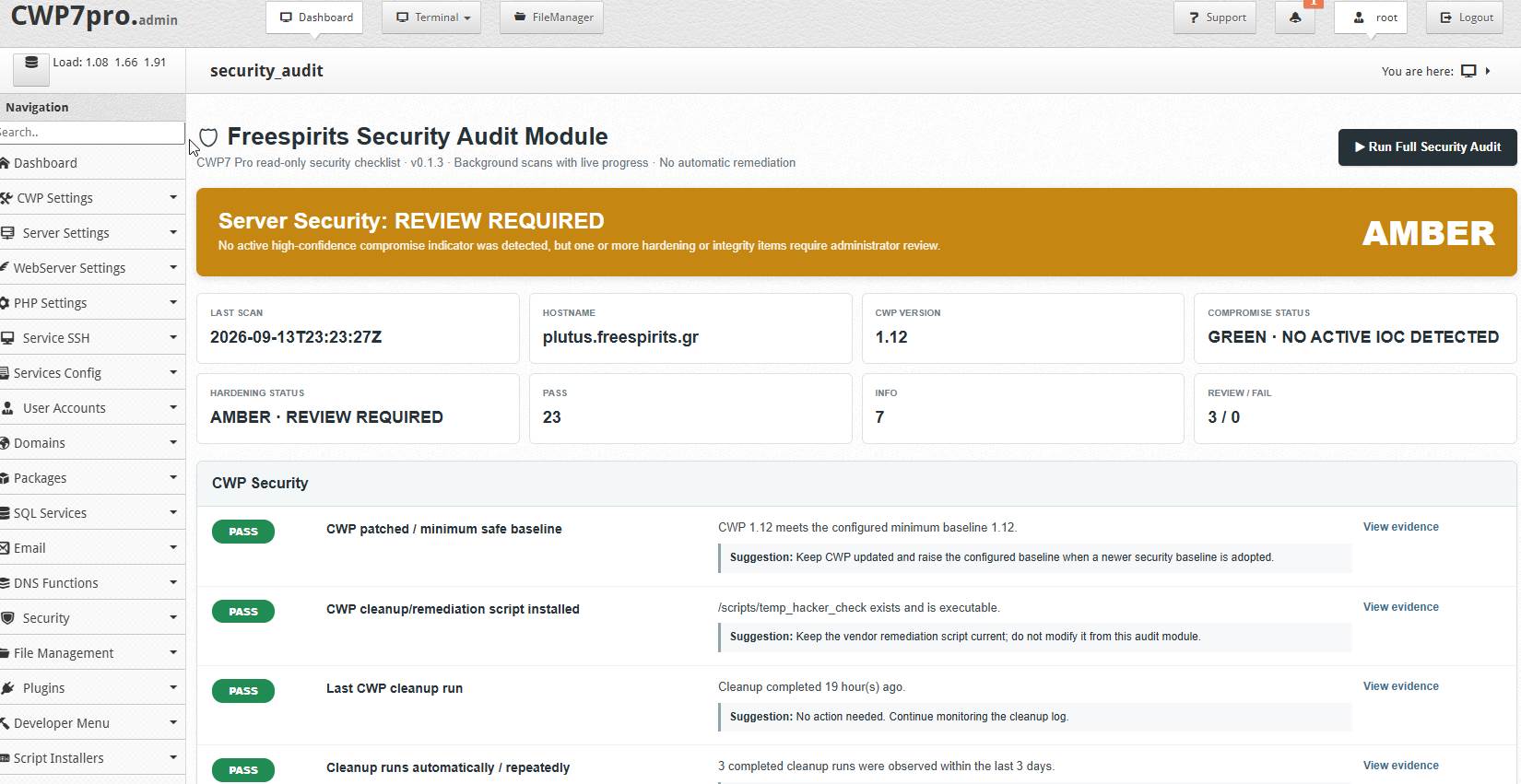
El módulo de auditoría de seguridad de CWP7 ofrece a los administradores de servidores una forma rápida, estructurada y de solo lectura de evaluar el estado de seguridad de un servidor CWP7 Pro directamente desde la interfaz habitual de CWP.
With one full audit, it checks for high-confidence indicators of compromise, persistence mechanisms, suspicious SSH activity, webshells, malicious files, unsafe service exposure, firewall issues, PHP injection, system integrity concerns and important hardening opportunities.
Unlike generic scanners, it is designed specifically for real CWP7 environments and helps distinguish between compromiso activo, pruebas históricas, conclusiones informativas y recomendaciones de configuración, reducing unnecessary false alarms.
Includes Resultados claros de «APROBADO», «INFORMACIÓN», «REVISIÓN» y «SUSPENSO», conclusiones basadas en pruebas, orientación práctica para administradores, análisis de antecedentes, historial de análisis y evaluaciones independientes de vulnerabilidades y refuerzo de la seguridad.
A powerful security-verification layer for hosting providers, agencies, VPS administrators and anyone who wants to comprender qué está ocurriendo en su servidor CWP7 sin permitir que un escáner automático realice cambios destructivos.
Professional Read-Only Security Auditing for CWP7 Servers
Turn a complicated Linux security investigation into a structured, understandable security assessment directly inside your CWP7 administration panel.
✓ Solo lectura por diseño ✓ CWP7-Aware Detection ✓ Conclusiones basadas en la evidencia ✓ Análisis de antecedentes
Why Every Serious CWP7 Administrator Needs Better Security Visibility
A alojamientoservidor may contain hundreds of processes, thousands of files, multiple PHP versions, WordPress installations, scheduled jobs, firewall rules, SSH keys, system services, database listeners and CWP-specific components.
Para saber si todo funciona con normalidad, puede ser necesario utilizar docenas de comandos de Linux, revisar manualmente los registros, realizar búsquedas en el sistema de archivos, examinar los procesos e interpretar con cuidado los resultados sin procesar.
El verdadero reto no consiste simplemente en recopilar información.
The challenge is knowing which findings actually indicate danger — and which are simply normal characteristics of a CWP7alojamientoservidor.
CWP7 Security Audit Module brings these checks together into one structured interface so administrators can quickly understand what deserves attention.
One Click. A Much Clearer Picture of Your Servidor.
Instead of manually remembering and executing numerous security commands, the administrator can launch a comprehensive assessment directly from CWP7.
Realizar una auditoría de seguridad completa
↓
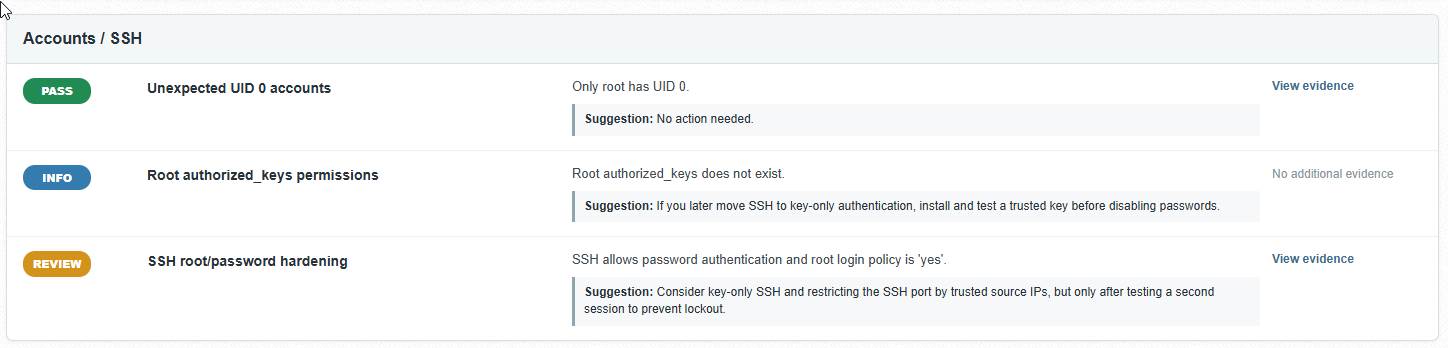
PASS
INFORMACIÓN
Reseña
FALLO
Los resultados se organizan en estados claros, acompañados de datos y orientación práctica, para que el administrador pueda decidir qué es lo que realmente requiere una intervención.
Not Every Warning Means Your Servidor Is Compromised
Esta es una de las diferencias más importantes entre una auditoría de seguridad útil y un escáner de seguridad que solo genera alertas innecesarias.
Servicios internos de CWP gestionados por el usuario root
pruebas de vulnerabilidades anteriores conservadas en los registros
Puede que estos resultados merezcan una revisión, pero sí que... no significa necesariamente que un atacante controle actualmente el equipo.
Al mismo tiempo, conclusiones como:
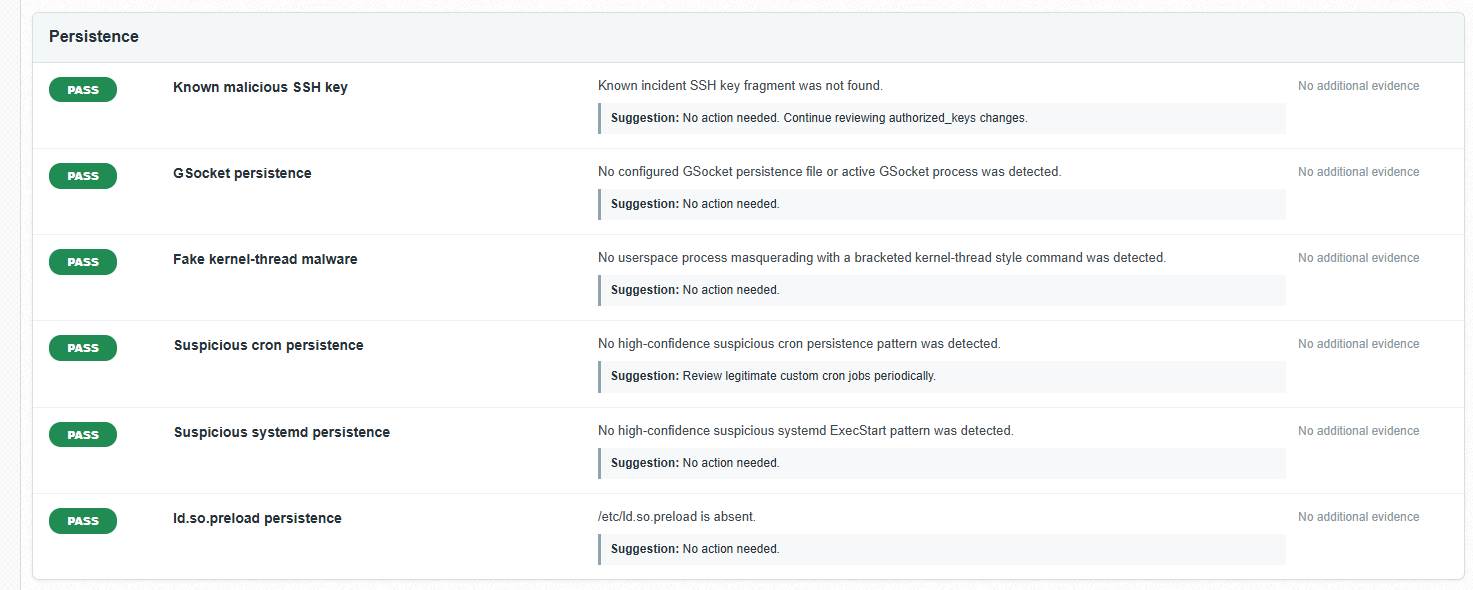
claves SSH maliciosas conocidas
mecanismos de persistencia sospechosos
Conexiones C2 de un atacante activo
firmas de webshell
malware que simula un hilo del núcleo
cuentas con UID 0 no autorizadas
merecen un nivel de atención muy diferente.
CWP7 Security Audit Module is designed to help distinguish between security hardening opportunities and evidence that may indicate an active compromise.
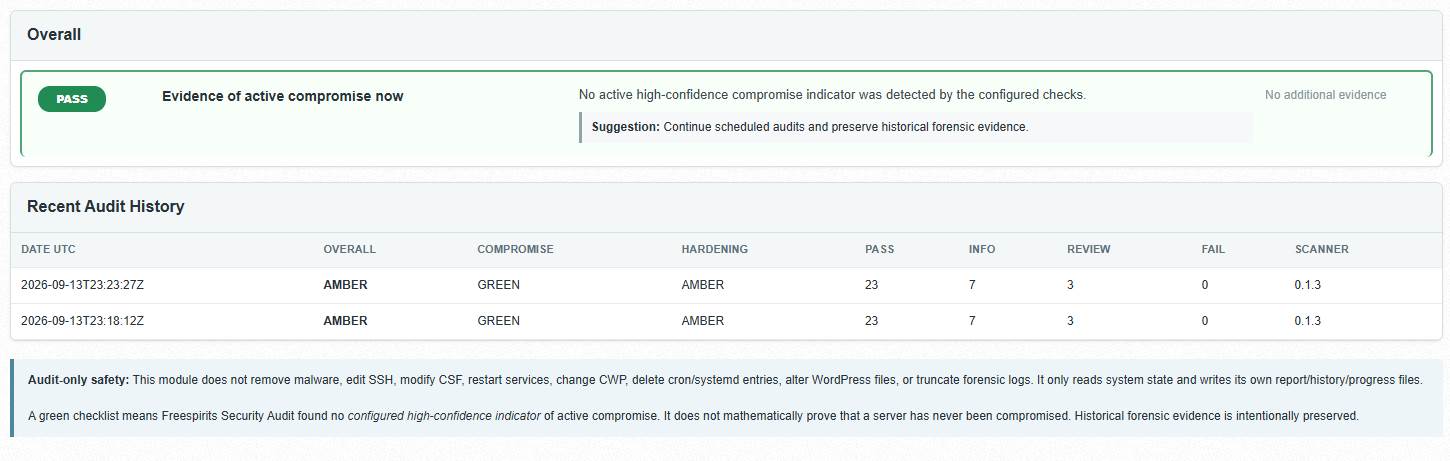
El estado de compromiso y el estado de refuerzo no son lo mismo
A servidor can be free from detected high-confidence compromise indicators while still having configuration improvements worth reviewing.
ESTADO DEL ACUERDO
VERDE
No se ha detectado ningún IOC activo configurado
ESTADO DEL ENDURECIMIENTO
ÁMBAR
Mejoras en materia de seguridad que conviene revisar
Esta distinción contribuye a reducir el pánico innecesario, al tiempo que garantiza que los riesgos reales sigan siendo visibles.
Los escáneres de seguridad genéricos para Linux suelen carecer de contexto.
CWP7 servers have their own architecture, internal PHP-FPM services, API listeners, firewall configuration, alojamiento directories, WordPress environments, scheduled processes and servidor-management components.
Un escáner genérico puede detectar un comportamiento inusual y calificarlo inmediatamente de peligroso.
CWP7 Security Audit Module is designed with the CWP7 environment in mind.
Por ejemplo, puede reconocer el comportamiento interno legítimo de CWP, comprender la relación entre CSF y LFD, evaluar si un servicio de escucha está realmente expuesto a través del cortafuegos y tratar las pruebas antiguas de exploits de forma diferente a las actividades sospechosas recientes.
El contexto es importante. El objetivo es obtener información útil sobre seguridad, no cientos de alertas sin sentido.
Solo lectura por diseño
One of the strongest principles behind CWP7 Security Audit Module is simple:
An audit tool should not silently change the servidor it is auditing.
El módulo no realiza automáticamente lo siguiente:
eliminar archivos sospechosos
eliminar claves SSH
terminar procesos
desactivar servicios
modificar las reglas del cortafuegos
reiniciar Apache o Nginx
modificar la configuración de CWP
modificar la configuración de SSH
editar archivos de WordPress
eliminar tareas programadas
modificar los servicios de systemd
truncar los registros forenses
En cambio, le indica al administrador:
Qué se ha descubierto. Por qué es importante. Qué pruebas respaldan el hallazgo. Qué se debería tener en cuenta a continuación.
Why Read-Only Security Matters on Production Alojamiento Servers
Production alojamiento environments contain customer websites, custom scripts, plugins, caching systems, cron jobs, integrations and application files that may look unusual to an automated scanner.
Eliminar o modificar algo automáticamente basándose únicamente en una firma puede generar un segundo problema al intentar resolver el primero.
CWP7 Security Audit Module keeps the administrator in control.
Investiga primero. Analiza las pruebas. Comprende el contexto. A continuación, decide si es necesario actuar.
Por qué es una herramienta tan potente para los administradores
Investigación más rápida
Sustituye una larga secuencia de comandos manuales de Linux por una evaluación de seguridad estructurada desde una única interfaz.
Mejores decisiones
Distingue los indicadores reales de compromiso de las recomendaciones de configuración y los hallazgos de carácter informativo.
Pruebas a petición
Analiza las pruebas que sustentan las conclusiones pertinentes, en lugar de fiarte de una señal de alerta roja sin explicación.
Reducción de los falsos positivos
CWP7-aware logic provides more useful results than treating every unusual file, process or service as malicious.
Conciencia histórica
Conservar las pruebas de incidentes pasados sin presentar erróneamente un hecho antiguo como prueba de que se está produciendo un ataque en este momento.
Control de administrador
El módulo informa y explica. El administrador decide qué hay que cambiar.
Una auditoría de seguridad exhaustiva en un solo módulo
The module brings together checks covering CWP security, system integrity, persistence, networking, web content, firewall configuration and servidor hardening.
Área de seguridad
Qué se evalúa
Pautas básicas de seguridad de CWP
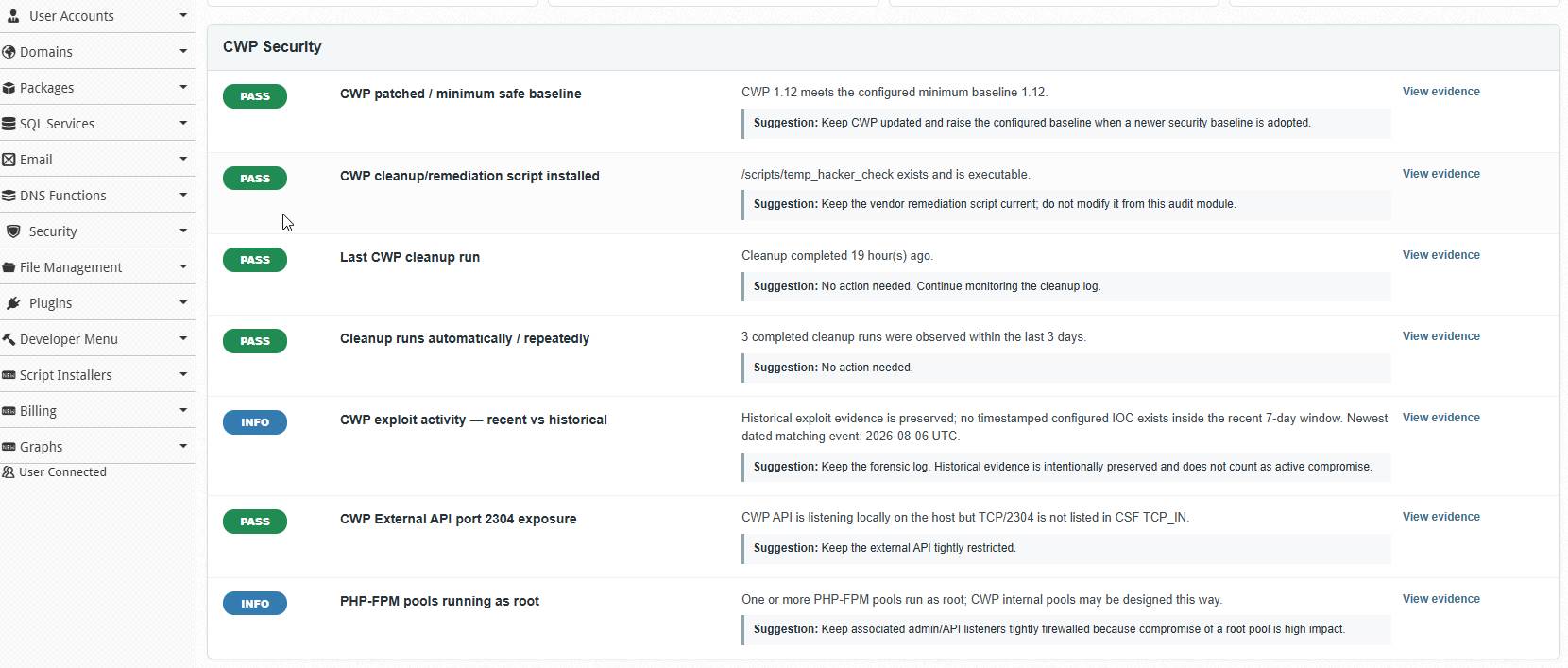
Versión de CWP, scripts de corrección, actividades de limpieza y pruebas de explotación.
Exposición de la API de CWP
Estado de escucha y exposición al cortafuegos de los servicios sensibles de la API de CWP.
Seguridad de SSH
Claves maliciosas conocidas, permisos de la clave raíz y configuración de la autenticación mediante nombre de usuario y contraseña de root.
Detección de persistencia
Tareas programadas (cron jobs), servicios de systemd, actividad de GSocket y mecanismos de ld.so.preload.
Indicadores de malware
Hilos falsos del núcleo, nombres de archivo maliciosos, patrones de webshell y actividad IOC conocida.
Conexiones de red
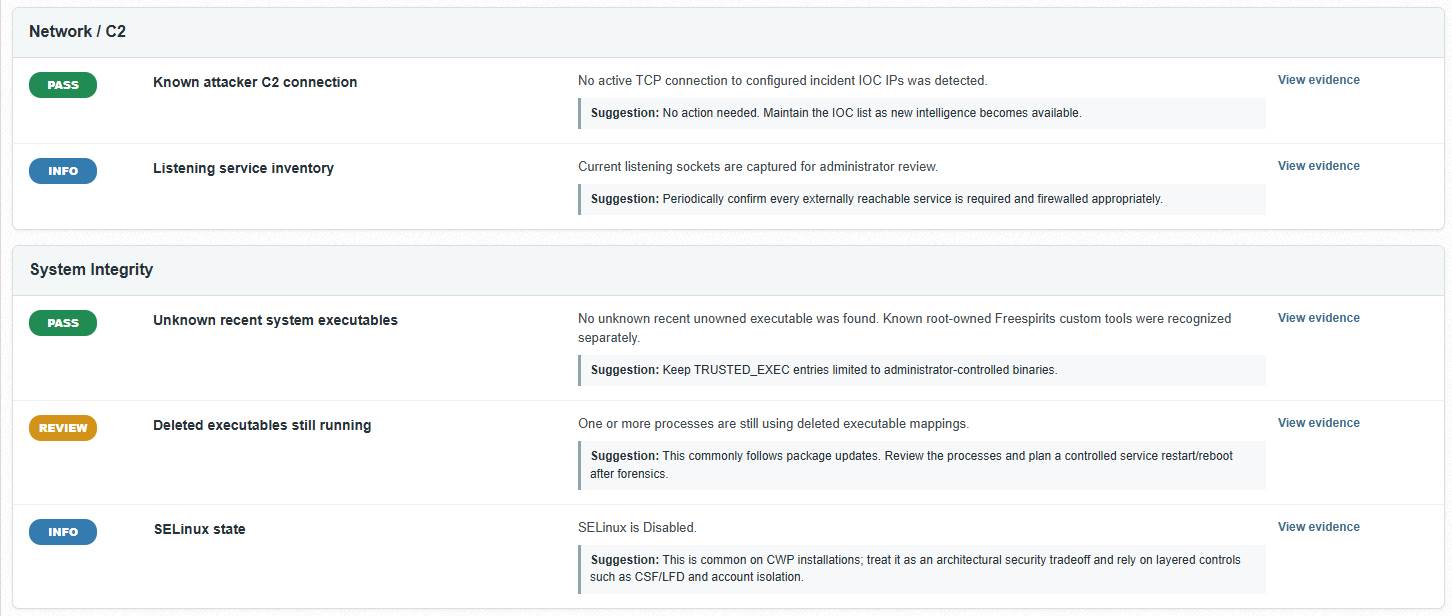
Servicios de escucha y conexiones activas frente a los indicadores de atacantes configurados.
Archivos ejecutables desconocidos
Recent executable files not owned by installed RPM packages.
Ejecutables en ejecución eliminados
Procesos que siguen utilizando archivos binarios que se han eliminado o sustituido.
Revisión de privilegios
Cuentas inesperadas con UID 0 y condiciones de seguridad a nivel de root.
Seguridad de Webroot
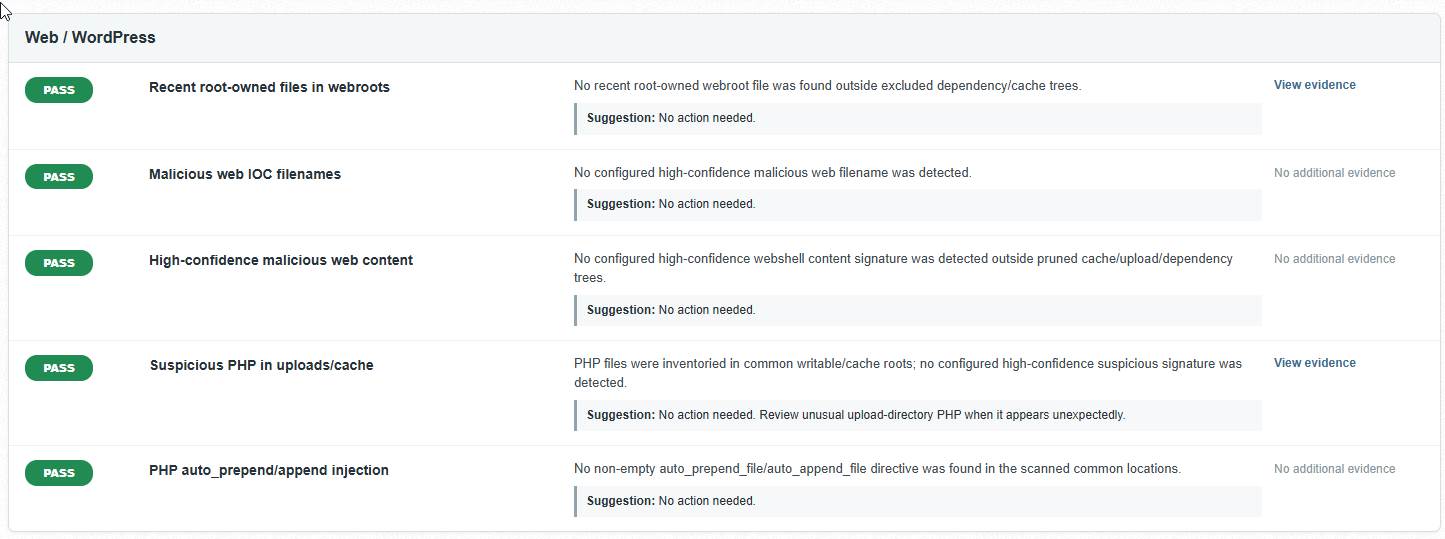
Archivos web propiedad del usuario «root», nombres de archivo sospechosos, ubicaciones PHP con permisos de escritura y firmas de webshell.
Inyección de PHP
Configuración sospechosa de «auto_prepend_file» y «auto_append_file».
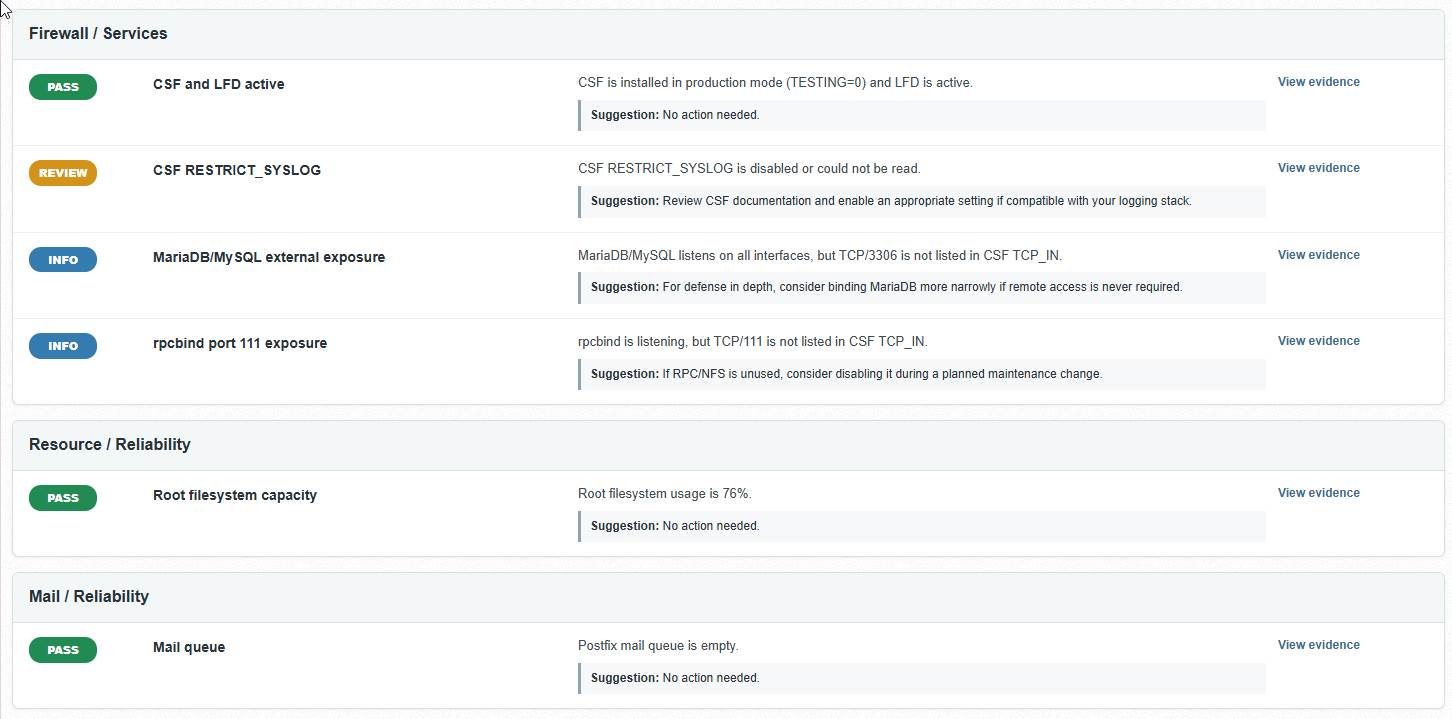
Estado del cortafuegos
Modo de producción de CSF, estado de LFD y configuración relevante para reforzar el cortafuegos.
Exposición de la base de datos
Comportamiento de escucha de MariaDB/MySQL y exposición real al cortafuegos.
Servicios del sistema
rpcbind y otros servicios de escucha que deben ser revisados por el administrador.
WordPress alojamiento environments are particularly difficult for simplistic security scanners.
Plugins, caching engines, upload directories, vendor libraries and application frameworks can legitimately contain PHP files in locations that may initially appear suspicious.
Basta con declarar todos los archivos PHP que hay dentro de un directorio llamado caché o subidas Un programa malicioso generaría un gran número de falsos positivos.
CWP7 Security Audit Module uses contextual checks and treats writable-directory PHP separately from high-confidence malicious signatures.
El objetivo no es elaborar el informe más extenso.
El objetivo es generar un informe que el administrador pueda utilizar realmente.
Las pruebas históricas siguen siendo visibles
Las pruebas de seguridad no deberían desaparecer simplemente porque un incidente haya ocurrido en el pasado.
Si en los registros conservados persiste actividad relacionada con vulnerabilidades antiguas, el módulo puede presentarla como información forense histórica sin que ello signifique automáticamente que se trate de una prueba de un ataque activo en la actualidad.
INFORMACIÓN — Se han conservado pruebas históricas de la vulnerabilidad; no se ha detectado ningún indicador de compromiso (IOC) configurado dentro del periodo de actividad reciente.
Esto aporta un contexto valioso y, al mismo tiempo, evita que los administradores lleguen a conclusiones erróneas.
Conservar las pruebas
El módulo evita deliberadamente borrar o recortar los registros forenses.
Los registros históricos pueden resultar de vital importancia a la hora de investigar cómo se produjo un incidente, determinar su cronología o comparar la actividad entre varios análisis.
Escaneo en segundo plano con indicación del progreso en tiempo real
Large alojamiento servers may contain many accounts and extremely large webroots.
Una auditoría exhaustiva no debería obligar a un administrador a mantener abierta una solicitud del navegador mientras se examinan miles de archivos.
The module therefore performs full audits in the background and can report the current scanning phase and progress through the CWP7 interface.
CWP SecurityAnálisis de persistenciaIntegridad del sistemaInventario webContenido webPHP con capacidad de escrituraCortafuegos y serviciosEvaluación final
Las fases de análisis que requieren mucho tiempo también pueden utilizar límites de tiempo configurados, de modo que los sitios web de tamaño inusualmente grande no mantengan una auditoría en ejecución de forma indefinida.
Una advertencia resulta más útil cuando se entiende por qué existe
Entre los resultados relevantes se incluyen datos que se pueden ampliar, de modo que el administrador pueda investigar directamente desde la interfaz del CWP.
En lugar de limitarse a mostrar:
REVISIÓN — Se ha detectado una situación sospechosa
El administrador puede consultar la información de apoyo y comprender qué es lo que realmente se ha encontrado.
También se incluyen sugerencias prácticas cuando procede.
Por ejemplo, las directrices para reforzar la seguridad de SSH pueden recomendar pasar a una autenticación basada únicamente en claves, al tiempo que se recuerda al administrador que compruebe que existe una segunda sesión de SSH operativa antes de desactivar el acceso mediante contraseña.
Del mismo modo, la eliminación de un archivo ejecutable puede explicarse como una situación que a veces se produce tras las actualizaciones de software, en lugar de calificarse automáticamente como malware.
Información útil sobre seguridad sin crear pánico innecesario.
Realiza un seguimiento de tu estado de seguridad a lo largo del tiempo
Un único análisis te indica lo que el módulo ha detectado en un momento determinado.
Scan history makes that information more useful by allowing administrators to review how the servidor’s security posture changes over time and which scanner version generated each assessment.
For a alojamiento provider, security is not only about protecting one website.
It is about maintaining confidence in the entire servidor platform alojamiento customer websites, email services, applications and business-critical data.
CWP7 Security Audit Module gives Freespirits Network Alojamiento an additional internal verification layer directly inside the same CWP7 environment used to manage its servers.
Los administradores pueden llevar a cabo rápidamente una auditoría estructurada sin tener que ejecutar manualmente docenas de comandos de diagnóstico.
Verificación más rigurosa de los incidentes
Tras una actividad sospechosa, la aplicación de parches o la corrección de incidencias, el módulo ofrece otra forma de buscar indicadores conocidos que aún requieren atención.
Procedimientos coherentes
Las comprobaciones de seguridad pasan a ser repetibles, en lugar de depender por completo de los comandos de Linux que el administrador recuerde en ese momento.
Ver increíbles características adicionales y detalles
Información adicional
Compatibility
CWP7 Pro, CWP7
License Type
Lifetime License
Server Activations
1 Server
License Binding
Public Server IP
Payment Type
One-Time Payment
Audit Mode
Read-Only Security Audit
Security Checks
CWP Security, Persistence, Network/C2, SSH, Firewall, Web/WordPress, System Integrity
Audit Results
PASS, INFO, REVIEW, FAIL
Scan Method
Background Scan with Live Progress
License Security
Ed25519 Signed License Verification
189,00 €El precio original era: 189,00 €.67,00 €El precio actual es: 67,00 €.
Latest Changes
v0.5.37
Minor
Version 0.5.37 introduces automatic Maldet coordination to prevent duplicate monitoring and unnecessary scheduled scans on CWP7 Pro servers running AlmaLinux 8 or 9.
v0.5.36
Seguridad
Independent result verification: If Maldet's captured output is incomplete, Security Audit can corroborate the scan using Maldet's own event log.
Strict matching: The file-list path, process ID, file counts, and saved report must all agree before a successful result is accepted.
Reduced resource waste: After three consecutive engine failures, the assistant backs off for five minutes instead of repeatedly rescanning.
Better diagnostics: Future incomplete results record which evidence was available, making persistent problems easier to diagnose.
No security regression intended: Original detection, quarantine, strict CSF attribution, Rapid Watch, configurations and existing evidence remain preserved.
v0.5.33
Major
This was a major focus of the new version.
- Only one Maldet worker, not multiple parallel scanners.
- Maximum 8 files per batch by default.
- 45-second timeout per batch.
- Low CPU and disk I/O priority.
- Deduplication prevents repeated identical file events from causing unnecessary scanning.
- No additional inotify watcher.
- No automatic full-website Maldet scan triggered by a file change.
What has NOT changed yet?
There are three important limitations:
1. Maldet-only detections do not automatically quarantine files. They become REVIEW REQUIRED unless Freespirits independently confirms the malware.
2. It does not automatically monitor every file in every website. Its coverage still depends on your existing inotify scope. For broad coverage, we need All Webroots with sufficient watcher capacity.
3. Strict CSF attribution is unchanged. The module still blocks an IP only when it can establish that the IP uploaded the malicious file. Maldet helps identify malware, not the attacker.
v0.5.32
Seguridad
In v0.5.31, an important limitation remained: Apache/Nginx can record the HTTP response after the malicious file was written. The scanner could reject that request because its timestamp was several seconds too late.
Version 0.5.32 improves this:
- Recognizes delayed successful upload responses within carefully bounded time windows.
- Handles up to 45 seconds of response-completion delay for explicit upload requests and matching JCE-named webshells.
- Preserves a tighter eight-second allowance for less-specific JCE requests.
- Records why uploader attribution failed, including available domain logs and candidate counts.
- Keeps normal ENFORCE behavior unchanged when Strict mode is OFF.
v0.5.31
Seguridad
Strict CSF remains enabled on servers where you already activated it. No additional acknowledgment required.
Confirmed malware must still pass verified exact-hash quarantine checks.
Competing or unverified uploader IPs cannot trigger bans.
Administrator IP exclusions and CSF safety checks remain active.
Historical reconciliation cannot trigger retroactive attacker bans.
Existing malware signatures, scanning coverage, license and saved configurations are preserved.
v0.5.30
Seguridad
v0.5.30 improves the detection of the newly discovered malicious file and its unusual extension. The latest action only renamed the ZIP to match your standard installation naming convention.
v0.5.28
Seguridad
The key change is that file modification time no longer determines strict live-upload eligibility. Instead, the module records the inotify event timestamp and compares it against the matching HTTP write request. A verified event can remain eligible despite processing delays, subject to a bounded two-hour event window. Strict mode still refuses blocks when it cannot establish the actual uploader, when the IP is protected, or when quarantine and CSF safeguards fail. Historical scans can quarantine confirmed malware but cannot trigger retroactive IP bans.
v0.5.26
Bugfix
GUI Improvements
v0.5.25
Bugfix
1. Removed the confusing saved-file recheck interface. The “Fast verification of saved suspicious files” button, explanation and progress panel have been removed from Findings. Existing protected forensic evidence and internal recheck capabilities remain intact, alongside Immediate Inspection, Full Audit and automatic containment.
2. Clarified historical malware warnings. An older Full Audit FAIL no longer presents its original alarming summary as though it were a newly detected infection when a newer Immediate Inspection exists. The original verdict, explanation and recommendations remain available in expandable evidence details.
3. Improved the previously reported malware status. The dashboard now distinguishes files that still match known malicious hashes, files verified in the module quarantine, files missing from their original locations, and changed or unreadable files. Missing files are not falsely called quarantined, while a confirmed matching malicious file still produces a prominent warning.
4. Fixed the reconciliation checkbox layout. The checkbox and label are now separate, correctly associated elements with scoped layout styling to prevent overlap in CWP7.
v0.5.24
Seguridad
Freespirits Security Audit v0.5.24 corrects the historical reconciliation shutdown and managed-update deferral workflows. Disabling independent historical reconciliation now removes its scheduled execution and requests termination of the active supervised worker while preserving the last durable checkpoint. Legitimate update-lock deferrals are distinguished from failed installations, preventing unnecessary rollback and service restarts. The Threat Intelligence — Teach the Scanner interface has been moved into an expandable Settings section, retaining administrator SHA-256 submissions, review-first classification, explicit malware confirmation and removal controls. Existing Rapid Watch/inotify, malware detection, automatic quarantine, CSF/LFD safeguards, licensing, saved configurations and forensic history remain preserved.
v0.5.23
Bugfix
Corrected the readiness-record version mismatch that caused v0.5.22 to roll back on Olympus. The root publisher, activation worker, GUI and transactional installer now use a shared release identity. Added mandatory pre-install regression testing to prevent the same problem recurring in future releases. The existing rollback protection remains active, and all malware detection, automatic quarantine, Rapid Watch/inotify, CSF/LFD enforcement, administrator settings, Threat Intelligence, licensing and forensic evidence are preserved.
v0.5.22
Minor
Historical Full Audit compromise findings are now clearly distinguished from newer Immediate Inspection results. Previous FAIL evidence remains preserved, but is labeled SAVED FAIL — current status not reverified, rather than presented as a newly detected active compromise. Current exact-file reconciliation now includes confirmed findings from both saved scan streams. The interface also clarifies that .xml.php is already eligible for PHP inspection, that the quarantine counter covers only module-managed evidence, and that automatic CSF blocking requires independently verified, attributable attack evidence.
v0.5.21
Seguridad
Restored the previously removed Threat Intelligence administrator tab, including manual SHA-256 registration, hosted-file hash verification, REVIEW-only submissions, independently confirmed malware approval and administrator indicator removal. Added direct submission from saved review findings and corrected the registry cache so newly saved decisions are immediately reflected. Preserved the built-in malware database, historical evidence, Rapid Watch, CSF/LFD safeguards, automatic containment authorization, licensing, configuration and rollback behavior.
v0.5.19
Seguridad
The 15 independently verified malicious SHA-256 hashes from Olympus are now permanently included in the built-in threat intelligence. Previously, v0.5.18 returned REVIEW for all 15. The updated verifier returns CONFIRMED_MALICIOUS.
v0.5.18
Minor
Improved incident-status reliability by separating historical RED security findings from the current exact-file containment state. Verified quarantine, active malicious hashes and unresolved files are now reported independently without requiring another full inspection merely to display containment. Completed saved-file rechecks are clearly distinguished from historical audit results, and duplicate follow-up inspection actions have been removed. Automatic CSF decision history now records the module build, configuration-read status and effective protection settings for more accurate troubleshooting. Existing malware detection, Rapid Watch/inotify, IPv4/IPv6 safeguards, CSF/LFD enforcement, quarantine verification, settings preservation, licensing and transactional rollback are retained.
v0.5.17
Minor
Freespirits Security Audit v0.5.17 fixes repeated manual restarts of saved-file verification by automatically continuing existing bounded checkpoints in one background operation. It improves read-only verification messages, preserves incomplete evidence when work cannot finish, and retains all existing malware-detection and quarantine safeguards. No new administrator features or scan modes were added.
v0.5.16
Bugfix
Historical reconciliation: Saving this option no longer triggers an unrelated CSF safety-test requirement. The existing signed form, configuration locks and CSF protection remain in place.
v0.5.15
Major
Freespirits Security Audit v0.5.15 adds six independently verified Olympus malware signatures covering command webshells, disguised uploaders and PHP engine-exploitation payloads. Existing suspicious-file findings can now be classified through the fast targeted recheck and quarantined under established safety rules, without another server-wide inspection. Dangerous JCE configuration files remain review-only to avoid unjustified containment. No new features or settings were introduced.
v0.5.13
Bugfix
v0.5.13 repairs the existing request-triggered PHP verification worker so it can discover verified CWP hosting accounts from Nginx configurations when /etc/userdomains is absent. It correctly recognizes ordinary and SSL domain logs, preserves processing cursors, reports DEGRADED when coverage is genuinely unavailable, and prevents repeated identical warnings from flooding the cron log.
v0.5.12
Bugfix
Freespirits Security Audit v0.5.12 adds an independent, security-validated Save operation for Request-triggered PHP verification, preventing the unrelated large Automation form from blocking this particular setting. It also prevents the larger form from resetting this option and improves its error messages to identify missing form fields without exposing sensitive data.
v0.5.11
Seguridad
The new version now includes a detector for the compressed-PHP loader family we investigated on Olympus. The independent SSH evidence supports this signature: the three tested files contain an executable-looking eval chain, valid Base64-compressed PHP, request handling and self-deletion indicators. I've also implemented a targeted REVIEW recheck that works from the saved findings without starting another 35-minute inspection. In a controlled fixture, it confirmed and quarantined the simulated concealed loader, while leaving a benign PHP file untouched.
v0.5.10
Major
Freespirits Security Audit v0.5.10 repairs the automatic quarantine authorization and settings-save workflow, prevents confirmed but uncontained RED-scan incidents from being incorrectly treated as fully handled, and enables safe reprocessing of the latest verified malicious-file ledger after explicit administrator authorization. The module prioritizes containment before verification scanning while preserving existing detection, CSF, inotify, licensing, historical reconciliation, forensic evidence and administrator settings.
v0.5.9
Bugfix
Freespirits Security Audit v0.5.9 repairs the confirmed Immediate Inspection PHP memory-exhaustion defect affecting large hosting accounts such as Olympus's infogat. It introduces streaming directory traversal and memory-efficient candidate tracking while preserving high-risk scan depth, hidden-PHP detection, existing administrator settings, historical evidence and security enforcement mechanisms.
v0.5.7
Seguridad
Improved false-positive assessment: Verified W3 Total Cache data can be classified as LIKELY_FALSE_POSITIVE without bypassing confirmed-malware hashes, additional executable PHP, or suspicious active HTML.
Cleaner dashboard: Removed the duplicate Most recent audit status and Most recent scan (either mode) cards. The independent Malware Inspection and Full Audit summaries remain.
Historical findings preservation: Before a new Immediate Inspection replaces the current report, the previous report's findings and SHA-256 evidence are archived separately. Historical findings won't inflate the current incident count.
v0.5.6
Bugfix
Freespirits Security Audit v0.5.6 improves dashboard organization, accurately distinguishes historical Full Audit evidence from current protection, and extends strict W3 Total Cache recognition to legitimate data layouts previously misclassified as suspicious. The release preserves existing scanning coverage, CSF enforcement rules, inotify monitoring, historical reconciliation and administrator settings without adding new controls.
v0.5.5
Bugfix
The scanner now recognizes a narrowly defined W3 Total Cache format only when the complete eligible file passes structural verification: correct cache-key layout, W3 Total Cache provenance, an unconditional PHP exit guard, and no additional executable PHP tokens. Matching files are classified as LIKELY_FALSE_POSITIVE rather than generating repetitive manual investigations. The existing full inventory uses the same verified result. Crucially, known-malware hashes, malformed entries, suspicious PHP and administrator-submitted review indicators retain their existing security treatment. Changed files are reassessed; historical evidence remains preserved.
v0.5.4
Bugfix
Freespirits Security Audit v0.5.4 corrects the CWP IPv4 CSF readiness display by separating confidential root-only security evidence from a minimal, read-only GUI status summary. It also strengthens release validation, including checks that previously READY IPv4 protection remains verifiable after an upgrade. Existing administrator settings, historical reconciliation evidence, Rapid Watch functionality, malware detection, licensing and CSF enforcement safeguards are retained.
v0.5.1
Seguridad
Freespirits Security Audit v0.5.1 improves CSF activation reliability by removing premature CWP page termination and moving PHP runtime discovery into a bounded background operation. The unused Threat Intelligence administration interface has been removed without sacrificing established malware signatures. Existing CSF, Rapid Watch, quarantine, security checks, settings, schedules and licensing protections are retained, with stronger post-upgrade readiness verification.
v0.5.0
Bugfix
Freespirits Security Audit v0.4.9 restores independent persistence of Malware Inspection and Server Security & Hardening Checklist reports. Immediate scans no longer hide the extensive PHP, CWP, CSF, PHP-FPM and persistence findings, while Full Audits preserve earlier malware-inspection evidence. The interface now displays distinct report dates, scope and coverage, and PHP-version risk acknowledgements remain associated with the correct server checklist. Existing detection, quarantine protections, inotify monitoring, CSF enforcement, licensing, scheduling and managed updates are preserved.
v0.4.9
Seguridad
Freespirits Security Audit v0.4.9 restores independent persistence of Malware Inspection and Server Security & Hardening Checklist reports. Immediate scans no longer hide the extensive PHP, CWP, CSF, PHP-FPM and persistence findings, while Full Audits preserve earlier malware-inspection evidence. The interface now displays distinct report dates, scope and coverage, and PHP-version risk acknowledgements remain associated with the correct server checklist. Existing detection, quarantine protections, inotify monitoring, CSF enforcement, licensing, scheduling and managed updates are preserved.
v0.4.8
Major
Freespirits Security Audit v0.4.8 corrects false incomplete-coverage results for parked PHP, ZIP archives and Vim swap files. It distinguishes source-code exposure from confirmed malware, detects suspicious fake swap files, and groups identical vendor-code findings without automatically trusting them. Existing PHP webshell detection, inotify monitoring, quarantine safeguards, CSF IPv4/IPv6 protection, licensing, scheduling and managed updates remain preserved.
v0.4.6
Seguridad
v0.4.6 restores deeper Immediate Inspection of high-risk directories, correctly identifies its own version, improves detection of disguised PHP, separates historical scanning from live inotify monitoring, reduces false positives from ordinary image data, and preserves full-file inspection in the Exhaustive Audit. Large PHP files are retained as explicit review findings instead of being silently discarded.
v0.4.5
Seguridad
What’s fixed: v0.4.5 aligns historical reconciliation with verifier candidate selection, confirms threat matches by exact SHA-256, explicitly skips ordinary non-candidates, excludes XML declarations from PHP detection, and statically inspects PHP embedded in supported media. It retains .php.gif, short-tag, obfuscated-PHP, and known-hash detection without executing samples. Failed, oversized, changed-type, or interrupted eligible files remain visible as incomplete and retryable; systemd output is concise and reports identify v0.4.5. Existing enforcement modes, CSF and dual-stack settings, Rapid Watch/inotify, license and threat-intelligence data, quarantine evidence, and update preferences remain preserved.
v0.4.3
Bugfix
Preflight catches PHP parser crashes before installation changes begin; transactional rollback restores prior module files and service states; upgrades preserve administrator, CSF, license, quarantine, and Rapid Watch settings; and reconciliation reports incomplete coverage instead of false completion. The Eenoiko backdoor hash is checked without executing the specimen. Automatic quarantine requires ENFORCE, explicit containment, exact live-hash verification, and a passing safety self-test.
v0.4.3
BugfixBeta
Preflight catches PHP parser crashes before installation changes begin; transactional rollback restores prior module files and service states; upgrades preserve administrator, CSF, license, quarantine, and Rapid Watch settings; and reconciliation reports incomplete coverage instead of false completion. The Eenoiko backdoor hash is checked without executing the specimen. Automatic quarantine requires ENFORCE, explicit containment, exact live-hash verification, and a passing safety self-test.
v0.4.2
Bugfix
Fixed the Rapid Watch detection gaps that allowed previously identified malicious PHP files to remain undetected in writable hosting directories. Added the verified Eenoiko .php.gif webshell SHA-256 to permanent built-in threat intelligence, implemented token-based detection of obfuscated split-string command execution, strengthened the inotify candidate filter, and introduced low-priority recursive historical reconciliation of monitored directories. The CWP administrator panel now distinguishes live monitoring from historical inspection and displays its coverage, malware confirmations, quarantines and failures. Automatic file quarantine explicitly requires ENFORCE mode, enabled containment, successful safety checks and live SHA-256 verification. Existing scanner functionality, Laravel support, administrator decisions, CSF protections, Rapid Watch settings, licensing, quarantine history and rollback safeguards remain included.
v0.7.30
Bugfix
Safe Emergency 504 Incident Reporting has been relocated into PHP-FPM Incident Email Alerts, where administrators can manage incident notifications, recipients and escalation emails together. Saving advanced recovery settings no longer accidentally changes SAFE-504 reporting. Previously saved settings, protected application accounts, Nginx policies, CSF and Cloudflare configurations are preserved. No changes were made to PHP-FPM worker termination logic.
v0.4.1
Seguridad
Expanded the age-independent Immediate Security Inspection to examine selected Laravel application source, controllers, models, configuration, routes, bootstrap files, views and writable directories. Corrected duplicate counting across overlapping inspection paths and introduced transparent verification statistics that distinguish discovered files from actual classification attempts. The dashboard now exposes scan evidence while preserving 100% execution progress independently of coverage completeness. All existing Findings review, exact-hash trust, forensic quarantine, CSF enforcement safeguards, Rapid Watch, Threat Intelligence, licensing, scheduling and rollback mechanisms remain included.
v0.3.99
Bugfix
Corrected Immediate Security Inspection to recognize and safely traverse legitimate same-account public_html symbolic links, including the Laravel deployment structure confirmed on Plutus. The scanner now validates canonical destinations and account ownership, inspects Laravel public and selected writable storage locations, and refuses broken, cross-account or escaping symlinks. Administrator preview, exact-hash trust and quarantine-restore path checks were also updated for authorized webroot aliases. Existing malware classification, AMBER findings, quarantine history, CSF policies, Rapid Watch configuration and administrator settings remain preserved.
v0.3.98
Seguridad
Separated inspection execution progress from security coverage verification. The progress bar now reaches 100% whenever the scanner finishes its run and publishes its report, regardless of outstanding review findings or unverified files. Coverage failures retain their exact paths and reasons in Findings, while AMBER and UNKNOWN assessments remain unchanged until properly resolved. Genuine crashes, watchdog interruptions, cancelled scans and failed report publication are never falsely marked as successfully finished. Existing scanning behavior, administrator review decisions, quarantine, CSF enforcement, Rapid Watch, scheduling and licensing are preserved.
v0.3.97
Minor
Added a complete administrator review workflow to Immediate Inspection findings, including safe read-only preview, exact-path and exact-SHA-256 trust decisions, acknowledgement without clearing unresolved security warnings, explicitly confirmed manual quarantine, and a persistent decision history. Trusted findings are excluded from future review counts only when the scanner independently classifies the unchanged file as reviewable rather than confirmed malicious. Existing scanning, CSF enforcement, Rapid Watch/inotify, Threat Intelligence, licensing, scheduling, quarantine history and upgrade settings are preserved.
v0.3.96
Minor
Corrected Immediate Security Inspection's handling of recognized Autoptimize compressed and uncompressed cache formats. The scanner now validates these files using bounded, read-only streaming, checks for PHP code and suspicious execution indicators, and records malformed or changing files as unresolved. Oversized Joomla PHP cache files receive memory-bounded static inspection and remain visible in Findings for administrator review rather than being silently marked clean or automatically quarantined.
v0.3.95
Bugfix
Corrected Immediate Security Inspection's incomplete-coverage reporting so file verification errors, unreadable directories, invalid high-risk paths and other scope failures are recorded with their actual locations and reasons. Added an Incomplete Coverage section under Findings, with account grouping and pagination. The dashboard now counts unresolved inspection items rather than misleadingly showing zero findings. No detection thresholds were reduced, and genuine incomplete inspections will not be falsely marked 100% complete.
v0.3.94
Bugfix
Corrected the overly sensitive resource watchdog that could stop an Immediate Security Inspection with ACTIVE_SWAPPING because of unrelated server-wide swap activity. Swapping now requires corroborating evidence of low available memory or sustained kernel memory pressure before cancellation. Critical memory and I/O safeguards remain active, and three consecutive readings of the same pressure condition are required. Added root-only diagnostic evidence for watchdog-triggered stops and corrected the progress display so elapsed time stops increasing after an interrupted audit.
v0.3.93
Bugfix
Fixed the missing Immediate Inspection review evidence that previously produced AMBER while displaying zero Findings. Each review candidate is now stored with its hosting account, file path, scan-time SHA-256, classification, risk score and detection rationale. Findings displays these records in a paginated, account-filterable review queue, and the dashboard counters reflect the same review totals. Historical reports that lack individual file details are identified honestly rather than silently cleared. Existing detection rules, quarantine safeguards, Rapid Watch, CSF ENFORCE, licensing, scheduled Immediate Inspection and optional Exhaustive Inventory remain unchanged.
v0.3.92
Minor
Added verified Eenoiko malware hashes, stronger inspection of PHP hidden in small non-PHP files, review-only recognition of suspicious JCE and PHP configuration artifacts, and administrator-managed threat signatures. Introduced a secure two-stage approval workflow while preserving Immediate Security Inspection as the default daily scan, optional Exhaustive Inventory, Rapid Watch, CSF protection, quarantine history, existing settings and licensing.
v0.3.91
Seguridad
Improved detection of standalone, HTTP-controlled PHP upload backdoors in public writable directories, including variants that assign $_FILES upload data to intermediate variables before invoking move_uploaded_file(). The verifier now recognizes the representative malicious patterns you supplied as CONFIRMED_MALICIOUS, while the local regression tests leave ordinary CMS upload handlers and non-executable examples unconfirmed. Existing daily Immediate Inspection, Exhaustive Inventory, CSF, Rapid Watch, quarantine safeguards, licensing and administrator settings are preserved.
v0.3.90
Bugfix
Corrected zero-byte PHP cache verification so stable empty files no longer produce false unresolved results. Added exact paths and reasons for remaining Immediate Inspection failures, improved memory efficiency by avoiding unnecessary expensive PHP tokenization, corrected the Joomla metrics parsing error, and changed the three Findings verification buttons to launch Immediate Security Inspection rather than Exhaustive Inventory. Improved incomplete-worker reporting so saved account progress is shown without falsely certifying coverage. Existing administrator scan settings, daily fast inspection, Rapid Watch, CSF enforcement, quarantine and licensing protections are retained.
v0.3.89
Bugfix
Redesigned the scan controls into a unified, responsive toolbar with consistent button dimensions, improved typography, clearer primary and secondary actions, and proper mobile alignment. The Stop Safely action remains available during active scans. All existing actions, settings, scheduled scans, Rapid Watch, CSF enforcement, quarantine and licensing behavior are retained.
v0.3.88
Seguridad
Freespirits Security Audit Module v0.3.88 introduces a dedicated, age-independent Immediate Security Inspection as the default manual and scheduled scan, covering high-risk locations across all discovered CWP hosting accounts. Exhaustive Inventory remains separately available, with optional administrator profiles and file-age settings. The module distinguishes immediate-inspection completion from exhaustive coverage, retains exact-hash malware verification and existing incident-response safeguards, and preserves configured scheduling, Rapid Watch, CSF, quarantine and licensing settings during upgrades.
v0.3.87
Seguridad
Added an age-independent Joomla temporary-directory security check that examines executable PHP directly inside every account's public_html/tmp directory before the expensive Full Audit stages. Confirmed malicious files now feed the existing security report, compromise assessment, and exact-hash incident-response system, without requiring the persistent inventory to reach that account first. Optimized the Writable PHP stage to use one filesystem discovery pass instead of multiple recursive searches, with explicit warnings if scanning cannot complete. Preserved all existing administrator settings, Full Audit profiles, 30-day selection, Rapid Watch, inotify, CSF protections, quarantine and licensing.
v0.3.86
Minor
Added a dedicated Settings tab and changed new-installation defaults to exhaustive, all-ages file inventory with unrestricted candidate and inventory-time limits. Existing administrator selections are preserved during upgrades. Improved scanning efficiency by increasing the excessively restrictive whole-process CPU and I/O budgets while retaining memory protection, reducing repeated cross-site hashing and duplicate classification work, and recording the duration of each scan phase. Scoped investigations are now clearly differentiated from exhaustive audits without concealing unverified files or incomplete coverage.
v0.3.85
Major
Freespirits Security Audit Module v0.3.85 introduces optional 30-day file-age scanning, improves the efficiency of JavaScript campaign discovery, adds reliable heartbeat updates during lengthy security scans, and corrects interrupted-audit status reporting. Existing administrator preferences, scan profiles, protection policies and persistent audit coverage are preserved.
v0.3.84
Minor
Fixed unexpected CSF and malware-containment policy changes during unrelated Security Audit GUI configuration saves. Introduced serialized configuration updates with protected-policy preservation and explicit administrator authorization for changes to IPv4/IPv6 blocking, ENFORCE, CSF response and containment controls. Removed implicit Web Defense containment toggles and the automatic reset of Rapid Watch block duration. Strengthened transactional upgrade preservation by eliminating legacy configuration migrations that could modify previously selected monitoring scopes or retired settings. Retained exact pre/post configuration checks, automatic rollback, existing services, monitoring, licensing, trusted settings, quarantine and forensic history.
Removed obsolete hardcoded version labels from current containment GUI headings and messages. Added a Recommended 180-day file-age option independently of the Default All Ages choice and existing manual age selections. Successfully completed 98 regression tests, PHP/Bash validation, installer preflight and fresh-ZIP integrity verification.
v0.3.83
Minor
Corrected Full Security Audit account starvation by adding persistent per-account directory cursors and fair round-robin scanning, allowing successive limited scans to continue unfinished coverage instead of repeatedly starting with the first hosting account. Improved resumable verification using exact SHA-256 matches, introduced cumulative account-coverage reporting, and prevented incomplete scans from presenting misleading GREEN compromise conclusions. Added independently tested detection rules for Olympus-style Joomla configuration disclosure, HTTP-controlled command execution, malicious upload handlers and remote PHP loaders. Preserved existing resource budgets, scan profiles, age filters, Stop/Resume, CSF IPv4/IPv6, ENFORCE, inotify, quarantine history and licensing. All 94 offline regression tests passed, including tests from a freshly extracted installation ZIP.
v0.3.82
Major
Added a separate administrator-controlled Full Audit file-age selector supporting All Ages, modified within the last 60/90/120/180 days and last modified more than 60/90/120/180 days ago. The new selection operates independently of scan intensity and its resource budgets. Added server-side age-setting validation, modification-time filtering, explicit excluded-file accounting and age-scope reporting. Age-restricted scans cannot certify full all-ages coverage or report excluded files as clean. Preserved existing Full Audit profiles, CPU/memory/disk-I/O protection, Stop/Resume functionality, Rapid Watch, inotify, CSF IPv4/IPv6, ENFORCE, quarantine, licensing and forensic history. All 91 offline regression tests and fresh-package installation preflight passed.
v0.3.81
Minor
Implemented whole-process CPU, memory and disk-I/O resource isolation for Full Security Audits, with AlmaLinux 8/9-aware cgroup handling and fail-closed protection when mandatory controls are unavailable. Added automatic cancellation under sustained resource pressure, a dedicated GUI Stop Audit action, and resumable PHP malware verification using root-only SHA-256 checkpoints. Interrupted scans remain explicitly incomplete and cannot replace the previous completed report. Scheduled audits now use the protected launcher, and installation is blocked while an existing Full Audit is still running. Existing CSF IPv4/IPv6, Rapid Watch, inotify, quarantine, incident-response policies, licensing and forensic history remain preserved.
v0.3.80
Minor
Added five administrator-selectable Full Audit scan profiles: Light, Recommended, Deep, Unlimited and Custom. Light is the default for new installations, while existing administrator-configured limits are preserved during upgrades.
Implemented automatic preset values, server-side validation and independent configuration saving. Corrected per-account scan limits so exhausting one hosting account's budget does not prevent investigation of subsequent hosting accounts. Incomplete coverage remains explicitly reported rather than being classified as a successful clean scan.
Preserved existing inotify monitoring, Rapid Watch settings, IPv4/IPv6 CSF protection, ENFORCE policy, automatic malware quarantine, trusted rules, licensing and forensic history. Successfully completed 88 offline regression tests, PHP/Bash validation, installation preflight and ZIP integrity verification.
v0.3.79
Minor
Fixed critical Full Security Audit coverage limitations that previously restricted malware discovery through hardcoded candidate counts, per-account quotas, deep-directory caps and scanner timeouts. Introduced exhaustive-by-default file inventory across discovered hosting webroots, expanded detection of PHP-like content concealed under alternative extensions, and removed the previous JavaScript discovery size and timeout restrictions.
Added optional administrator-controlled Full Audit limits, with zero representing unlimited scanning. Improved detailed coverage reporting, root-only evidence retention and explicit INCOMPLETE status whenever required files cannot be verified or scanning is interrupted.
Preserved existing Rapid Watch, inotify, polling fallback, automatic quarantine, IPv4/IPv6 CSF enforcement, incident-response settings, licensing and trusted administrator protections. Maintained resource-conscious background execution and independent malware-verification requirements to avoid compromising server availability or quarantining legitimate files from filename heuristics alone.
Validated the release with 84 passing offline regression tests, PHP/Bash syntax checks, installation preflight, full ZIP integrity verification and isolated exhaustive-scanning tests.
v0.3.78
Bugfix
Fixed a critical security configuration defect where saving unrelated Rapid Watch settings, including polling fallback and blocking duration, could unexpectedly disable previously enabled CSF automatic incident response. Added live configuration reconciliation, protection-preservation checks and automatic restoration attempts when unrelated settings modify independent CSF or containment policies.
Corrected inconsistent internal version identification that caused already-installed releases to appear as pending updates. Added independent version comparison to reject duplicate or older managed releases.
Improved Joomla and WordPress Web Defense incident management by distinguishing historical missing-configuration incidents from currently missing files. Added a dedicated read-only incident re-verification action, reliable scan completion checks, unique report identifiers and explicit failure messages when a report cannot be refreshed.
Preserved existing IPv4/IPv6 CSF selections, ENFORCE policy, inotify monitoring, polling preferences, automatic quarantine, administrator safeguards, licensing, trusted settings and forensic history. All 84 offline regression tests passed, including fresh installation-package validation.
v0.3.77
Seguridad
Fixed the JavaScript incident lifecycle so verified exact-hash quarantines no longer appear as currently active malicious files after containment. Security Audit now reconciles historical ACTIVE findings with the current file state and independently verified forensic quarantine manifests, distinguishing ACTIVE, CONTAINED — VERIFICATION REQUIRED, CHANGED, and MISSING WITHOUT VERIFIED QUARANTINE.
Improved the Incident Center with accurate status explanations, protection against stale-hash quarantine actions, and correct reporting of successfully quarantined JavaScript files in automatic incident-response totals. Historical RED evidence remains preserved, while incomplete JavaScript discovery scans are reported separately as coverage warnings.
Preserved existing inotify monitoring, automatic quarantine, CSF IPv4/IPv6 settings, incident-response policies, administrator safeguards, licensing, scheduled audits and forensic history through the established transactional upgrade process. Added regression coverage for active, quarantined, replaced, reinfected, missing, symlinked, and invalid forensic-evidence scenarios. All 79 offline regression tests passed.
v0.3.76
Seguridad
Fixed a critical false-negative malware detection issue where a confirmed Joomla PHP webshell received a low REVIEW score despite executing attacker-controlled POST data through an obfuscated filter_input-to-eval chain. Added independent PHP token and data-flow verification, exact recovered-malware hash recognition, and improved coverage across live file monitoring, scheduled audits and campaign sweeps, including hidden PHP files in Joomla extension directories. Confirmed malicious files are now eligible for automatic exact-hash forensic quarantine under previously enabled ENFORCE protection, without additional per-file confirmation. Added security warnings for vulnerable W3 Total Cache versions and strengthened dedicated PHP CLI runtime checks. Preserved existing IPv4/IPv6 CSF enforcement selections, inotify monitoring, licenses, trusted configurations, quarantine history and upgrade rollback protections. Automatic attacker-IP blocking continues to require verified original file-write attribution and successful firewall safety checks. All 68 offline regression tests passed.
v0.3.75
Seguridad
Fixed a critical containment gap where Freespirits Security Audit identified a confirmed malicious JavaScript loader but offered no quarantine action. Added a dedicated, independently verified JavaScript quarantine workflow to the Incident Center, including exact-SHA-256 verification, root-only forensic evidence preservation, quarantine manifests, history records and safe removal of the unchanged infected asset. Extended previously enabled automatic confirmed-malware containment to recognize strongly verified JavaScript campaign incidents without resetting administrator settings. Strengthened protection against false positives, changed files and unsafe paths. Existing CSF IPv4/IPv6 configuration, inotify monitoring, incident response settings, licensing, scheduled audits and administrator safeguards remain protected by the transactional upgrade mechanism. All 60 offline regression tests passed.
v0.3.74
Seguridad
Fixed a JavaScript malware triage defect that could keep the Incident Center RED after repeated audits by treating a known URL/string plus unrelated minified JavaScript operations as proof of an active loader. Added bounded, read-only exact-file verification that distinguishes directly connected malicious script loading (ACTIVE) from marker-only or unrelated vendor-bundle content (REVIEW), with comments and string literals handled separately. A timed-out JavaScript discovery now produces an explicit incomplete-coverage warning (exit 124) without manufacturing proof of compromise. Previously reported assets receive a bounded priority recheck, and administrators can recheck the exact reported asset in the GUI with its SHA-256 and reason recorded without rerunning a full audit. Existing inotify, quarantine, incident-response, IPv4/IPv6 CSF, licensing, email and monitoring selections are preserved by the transactional upgrade mechanism. No automatic deletion, IP blocking or trust-bypass is introduced by this update.
v0.3.73
Bugfix
Fixed a critical malware detection gap identified during the Flyup.gr Joomla compromise. Freespirits Security Audit now recognizes heavily obfuscated PHP remote loaders that reconstruct hidden URLs, retrieve external executable content using cURL or session-controlled sources, and execute the retrieved payload dynamically. Improved independent PHP token and data-flow verification to recognize these threats without relying on filenames, risk scores or direct request variables. Extended Rapid Watch candidate detection and resource-bounded nightly and campaign-sweep coverage into deeply nested Joomla component directories. Strengthened protection against false positives and symlink traversal while preserving previously configured inotify monitoring, CSF IPv4/IPv6 settings, automatic quarantine, incident-response policies, administrator exclusions, licensing and forensic history. All 41 local regression tests passed, together with package syntax and installation preflight checks.
v0.3.72
Bugfix
What's fixed
Fixed Security Audit update procedures to preserve every previously configured protection, including inotify monitoring, CSF IPv4/IPv6 controls, automatic malware quarantine, incident response policies, HTTP verification, CMS monitoring, audit schedules and custom administrator settings. Added post-installation checks that verify previously enabled services and scheduled tasks remain operational. Failed service restarts, missing monitoring schedules or unexpected configuration changes now trigger transactional rollback rather than silently disabling protection. Existing licensing, administrator safeguards, trusted configurations and quarantine evidence remain intact. Previously requested but unarmed CSF controls are explicitly identified without bypassing mandatory safety verification.
v0.3.71
Minor
What's fixed
Improved Freespirits Security Audit's ability to identify active PHP webshells outside the effective inotify monitoring scope by introducing an optional, resource-bounded HTTP-request-driven verification layer. Added detection candidates for suspicious Joomla extension endpoints, writable-directory PHP files and root-level backdoors such as those observed during the Flyup.gr incident. Strengthened request normalization, symlink protection, file-change revalidation, bounded processing queues and coverage reporting. Retained independent malicious-file verification, exact-SHA-256 quarantine, administrator-safe CSF enforcement and rollback protection. Extended dedicated PHP CLI compatibility through PHP 8.5 without modifying hosted account PHP-FPM versions. Existing monitoring, licensing, incident history and security settings remain protected during upgrades.
v0.3.70
Minor
What's fixed
Fixed the contradictory IPv4 CSF activation behavior that allowed an administrator-selected IPv4 auto-block setting to coexist with a disabled legacy Rapid Watch response switch. Improved inotify monitoring by distinguishing requested and effective coverage, adding resource-aware profile selection, and reporting degraded protection instead of silently presenting incomplete monitoring as healthy. Extended malware-verification candidates to include Flyup-style obfuscated PHP webshell behavior and broadened bounded nightly scanning into Joomla extension directories. Added per-account candidate limits to prevent one busy account from consuming the entire scan budget, and introduced dedicated Joomla front-controller integrity detection for unexpected PHP source exposure. Preserved existing security policies, license information, quarantine evidence and upgrade recovery safeguards.
v0.3.69
Seguridad
What's fixed
Improved detection of heavily obfuscated PHP webshells using a strict, token-based combination of dynamic code execution, HTTP input, filesystem modification functions, multiple goto statements, and encoded strings. Fixed the false-negative caused by treating a structured Joomla plugin path as mitigating evidence for this malicious behavior. Corrected automatic containment so independently confirmed malicious files anywhere inside an eligible hosted webroot can be quarantined without requiring attacker-IP attribution, while retaining exact SHA-256 verification, safety checks, administrator protections, and separate verified-source requirements for CSF blocking.
v0.3.67
Minor
What's fixed
Fixed upgrade-related protection-state resets in Freespirits CWP7 Security Audit Module. Removed installer logic that could overwrite administrator-selected containment and CSF response settings. Improved migration of older configurations to preserve enabled Rapid Watch and inotify monitoring. Added post-upgrade verification of critical security settings and previously running watcher services, with transactional rollback when preservation checks fail. Existing IPv4/IPv6 selections, ENFORCE policy, monitoring scopes, licenses, and forensic records remain intact.
v0.3.65
Minor
What's fixed
Added independent IPv4 and IPv6 CSF automatic-blocking controls to Freespirits Security Audit Module v0.3.65. Administrators can now enable, disable, and test each address family individually without affecting the other. Introduced guarded IPv6 firewall activation that validates kernel networking and CSF prerequisites, backs up the existing configuration, automatically sets IPV6=1, and reloads CSF with an independent emergency rollback timer and mandatory administrator confirmation. Added IPv6 reserved-address DENY verification, separate readiness reporting, and upgrade safeguards. Existing ENFORCE settings, licensing, quarantine evidence, and incident history remain preserved.
v0.3.64
Major
What's fixed
Added native IPv6 attacker detection, attribution, and guarded CSF temporary blocking alongside existing IPv4 protection. Both address families now use independent firewall readiness checks, validated source attribution, verified malicious-file quarantine, administrator IP protections, and CSF deny-rule verification. Added an IPv6 reserved-address firewall self-test, separate IPv4/IPv6 readiness indicators, source-family-aware incident notifications, and daily verification renewal. Existing ENFORCE settings, licensing, quarantine records, and historical evidence remain preserved.
v0.3.63
Major
What's fixed
Fixed missing progress feedback, ambiguous always-enabled quarantine controls, and duplicate sweep submissions in CWP7 Security Audit. Introduced asynchronous scanning with automatic status polling, visible processing stages, candidate counters, and clear completion/failure states. The quarantine action now requires recent confirmed findings and performs fresh malicious-content verification before containment. Also corrected PHP double-extension candidate discovery in the campaign sweep. Existing configurations, licensing, ENFORCE settings, quarantine records, and historical evidence remain preserved.
v0.3.62
Minor
What's fixed
Expanded the full-webroot protection workflow for CWP7 hosted accounts, addressing coverage gaps exposed by the Flyup Joomla compromise. Added persistent integrity monitoring for Joomla configuration.php and WordPress wp-config.php, including automatic disappearance/restoration alerts. Fixed Web Defense discovery of disguised PHP extensions such as .php.gif, preserved previously identified CMS installations after configuration-file disappearance, and introduced an optional time-bounded full-webroot scheduled scan. Existing ENFORCE, quarantine, CSF source verification, administrator safeguards, licensing, and upgrade settings remain intact.
v0.3.61
Bugfix
What's fixed
Fixed the automatic CSF blocking failure caused by an incorrect hardcoded SSH socket utility path. CWP7 Security Audit now securely discovers the ss executable across supported system locations, including /usr/sbin/ss and /usr/bin/ss, while preserving administrator SSH-session checks and protected-IP exclusions. Added live SSH socket-enumeration diagnostics to the CSF readiness checks so an unavailable command is reported instead of incorrectly displaying full readiness. Automatic ENFORCE protection, licensing, existing configurations, quarantine records, and incident history remain preserved.
v0.3.60
Minor
What's fixed
Fixed a confirmed defect preventing automatic CSF blocks of verified Joomla/JCE malicious-file injections. The targeted incident responder failed to load the RAPID_WATCH_ENABLED configuration value, causing the firewall policy to treat an enabled monitor as disabled. Corrected the configuration handling while retaining automatic ENFORCE protection, quarantine verification, attacker attribution, CSF safety checks, and administrator IP safeguards. Enhanced incident notification emails to include the correlated source IP, clearly labeled unverified IP candidates, and the specific CSF decision reason. Existing configuration, licensing, quarantine records, and incident history are preserved during upgrades.
v0.3.59
Major
What's fixed
Updated CWP7 Security Audit to use ENFORCE as its default incident-response policy, replacing the previous opt-in requirement for double-confirmed injection blocking. REVIEW ONLY is now an explicit administrator selection. Rapid Webshell Watch and Joomla/WordPress Web Defense can automatically respond to independently confirmed malicious injections after verified quarantine and attacker attribution. Missing Rapid Watch health-marker evidence no longer automatically prevents a qualified block. CSF safety tests, direct-origin verification, IP allowlists, and administrator protections remain mandatory.
Existing enabled injection monitors are armed for guarded enforcement during the upgrade. Disabled monitors are not automatically started.
v0.3.58
Bugfix
What's fixed
Freespirits Security Audit v0.3.58 introduces an administrator-controlled Double-Confirmed Injection Response policy to address confirmed Joomla/JCE malicious-file incidents that were previously skipped because Rapid Webshell Watch monitoring was inactive or its health status was unavailable. The enhanced workflow independently verifies the quarantined malicious file’s SHA-256 and stored forensic manifest before allowing an eligible, uniquely attributed attacker IP to proceed through the existing CSF blocking mechanism. All essential IP validation, administrator allowlists, direct-origin verification, CSF safety tests and firewall rule confirmation remain mandatory. Failed double-verification attempts and monitoring-health exceptions are now recorded clearly in the GUI incident history. Existing licensing, SSH brute-force settings, automated monitoring and upgrade recovery remain preserved.
v0.3.57
Bugfix
Improvements
- Automatic administrator IP protection: When you approve Save & Verify, the module detects your direct CWP public IP and adds that exact IP to csf.ignore if necessary.
- Save button corrected: It no longer remains disabled simply because your IP isn't already protected.
- Permanent SSH bans preserved: If CSF currently uses permanent bans, the form keeps that selection. You can optionally switch to a temporary ban of 1,440 minutes or another duration.
- Automatic backup and rollback: Protects both csf.conf and csf.ignore, verifies LFD after reloading, and restores the previous settings if the operation fails.
- Improved explanations: Clarifies why CWP7 can report many failed SSH logins despite active permanent bans.
v0.3.56
Minor
Additional safeguards
- Detects CSF/LFD readiness and existing protection settings.
- Requires your current administrator IP to be protected in csf.ignore.
- Backs up csf.conf before applying changes.
- Reloads CSF/LFD and checks the applied settings.
- Restores the previous configuration if activation fails.
- Displays recent SSH-related LFD activity.
- Preserves webshell monitoring, malware quarantine, licensing and existing security policies.
v0.3.55
Minor
What's improved
- Automatic inotify installation: Selecting and saving Rapid Webshell Watch with the inotify engine triggers installation when required.
- Non-blocking setup: Package installation runs separately from the CWP7 interface, preventing long waits or PHP request timeouts.
- Automatic activation: After successful installation, the module verifies inotifywait and requests watcher activation.
- Visible installation status: Queued, Installing, Installed or Failed, with diagnostic information.
- Safe failure handling: No silent switch to polling, no repeated installation loops and no false claim that monitoring is active.
- Licensing correction: Restored an accidentally changed license fingerprint field in v0.3.54.
v0.3.54
Major
What changed
Component Improvement
Universal upgrade path Detects installed version and performs a pre-upgrade backup
Installation recovery Automatic rollback on failure and recovery journal for interrupted upgrades
Rapid Webshell Watch Improved detection-to-CSF handoff
Joomla + WordPress Monitor Now uses the same verified-injection CSF backend
Joomla/JCE attribution Supports malicious files named alfa.php, Mushr00w_upl.php and similar
Malware containment No additional correlation score required for independently confirmed malware in writable web directories
Firewall protection Retains administrator IP, allowlist, proxy and CSF self-test safeguards
Incident reporting Records source IP, file hash, timestamps, attribution method and CSF decision
Important: The new JCE rule accepts a uniquely attributable successful POST within two seconds of the malicious file's modification time. This is strong temporal evidence, but not definitive proof of which request created the file. Automatic blocking therefore remains subject to the source-IP and CSF safety checks.
v0.3.53
Minor
The new correlation code and GUI changes are implemented. They address the specific pattern discovered on Olympus, where confirmed webshell detections coincided with successful POST /index.php?option=com_jce requests.
The blocking rule now requires all of the following:
- Independently confirmed malicious PHP and successful quarantine.
- A matching Joomla/JCE request within 15 seconds of the file modification time.
- One unambiguous public IPv4 source, with no competing successful POST sources in the correlation window.
- An incident no more than 10 minutes old, plus the existing CSF safety tests, IP protection checks and direct-origin verification.
v0.3.51
Bugfix
What I corrected
- PHP syntax preflight uses php -n -l, avoiding potentially broken PHP extensions and configuration during parsing.
- Every PHP file is still checked; syntax errors and crashes still stop installation.
- The installer reports the specific file and exit status when validation fails.
- Manual installation checks the complete package before changing installed files.
- Post-install checks and the updater's future health checks use the same isolated syntax validation.
- All existing Nginx attacker attribution, CSF safeguards, malware quarantine and email suppression features remain preserved.
v0.3.50
Bugfix
What's new
Feature v0.3.50
Nginx account/domain discovery Uses effective Nginx configuration
Access-log investigation Up to 24,000 lines / 8 MiB per log
Joomla JCE upload recognition Improved
Historical incident investigation New SSH forensic tool
Candidate attacker IPv4 identification Included
CSF temporary blocking Existing evidence-based protections retained
Email flood prevention Existing 24-hour repeat suppression retained
Cloudflare / false-block protection Preserved
The new forensic tool looks for matching HTTP activity around the actual incident times and reports candidate IPv4 addresses, request methods, timestamps, HTTP response codes and affected domains.
v0.3.48
Minor
What's improved
Feature Improvement
Repeat attacker emails Suppressed for 24 hours by default
Reminder options 6 hours, 24 hours, 3 days, 7 days
Global email protection Existing cooldown plus burst limit
CSF temporary bans Independently verified
Already-blocked attacker Recognized without another block command
Skipped CSF block Actual reason shown in CWP7
False blocked status Fixed DENY-only identification
Malware detection and quarantine Continue even when email is suppressed
The notification system now groups incidents by verified correlated IPv4 where available, or by the affected account and malware signature when IP attribution is uncertain. It does not assume two incidents share an attacker simply because they affect the same website.
Do you have any questions?
Do you have an additional request?
Please feel free to fill out the following contact form. We will be more than happy to work with you
Especialista técnico de FreespiritsFreespirits Web Services · Asistencia mediante IA
¡Bienvenido a Freespirits! Soy tu especialista en tecnología de IA. Puedo ayudarte con nuestros servicios de alojamiento, productos y cuestiones técnicas. ¿En qué puedo ayudarte hoy?
Por favor, preséntate para iniciar una conversación.
El asistente de IA puede cometer errores. No facilites contraseñas, números de tarjetas ni credenciales privadas del servidor.
¿Te gustaría recibir ayuda de una persona?
Tu chat está a punto de cerrarse. ¿Quieres que creemos un ticket de asistencia para nuestro equipo con tus datos y el historial de la conversación?
Se ha recibido una solicitud de asistencia
×
We've detected you might be speaking a different language. Do you want to change to:











 English
 Greek
 German
 French
 Spanish